

Iran claims missile barrage near US consulate in Iraq
Iraq’s Foreign Ministry on Sunday summoned Iran’s ambassador to protest the attack, calling it a flagrant violation of the country’s sovereignty.
No injuries were reported in Sunday’s attack on the city of Irbil, which marked a significant escalation between the U.S. and Iran. Hostility between the longtime foes has often played out in Iraq, whose government is allied with both countries.
The attack drew harsh condemnation from the Iraqi government, which called it a “violation of international law and norms” and demanded an explanation from the Iranian leadership. Iraq’s Foreign Ministry spokesman Ahmad al-Sahhaf told The Associated Press that the ministry summoned the Iranian ambassador, Iraj Masjedi, to deliver the diplomatic protest.
The United States said the missile strike emanated from Iran and strongly condemned it.
“The strikes were an outrageous violation of Iraq’s sovereignty. No U.S. facilities were damaged or personnel injured, and we have no indications the attack was directed at the United States,” State Department spokesman Ned Price told reporters in Washington.
Iran’s powerful Revolutionary Guard said on its website that it attacked what it described as an Israeli spy center in Irbil. It did not elaborate, but in a statement said Israel had been on the offensive, citing the recent strike that killed two members of the Revolutionary Guard. The semi-official Tasnim news agency quoted an unnamed source as saying Iran fired 10 Fateh missiles, including several Fateh-110 missiles, which have a range of about 300 kilometers (186 miles).
The source claimed the attack resulted in multiple casualties. There was no immediate comment from Israel on the allegations or the Iranian missile barrage.
An Iraqi official in Baghdad initially said several missiles had hit the U.S. consulate in Irbil, which is new and unoccupied, adding that it had been the intended target of the attack. Later, Lawk Ghafari, the head of Kurdistan’s foreign media office, said none of the missiles had struck the U.S. facility but that residential areas around the compound had been hit.
Following a Cabinet meeting, the Iraqi government in Baghdad reiterated its refusal to allow Iraq to be used to settle scores between other countries and said it has requested an explanation from the Iranian leadership.
Satellite broadcast channel Kurdistan24, which is located near the U.S. consulate, went on air from their studio shortly after the attack, showing shattered glass and debris on their studio floor.
The attack came several days after Iran said it would retaliate for an Israeli strike near Damascus, Syria, that killed two members of its Revolutionary Guard. On Sunday, Iran’s state-run IRNA news agency quoted Iraqi media acknowledging the attacks in Irbil, without saying where they originated.
The missile barrage coincided with regional tensions. Negotiations in Vienna over Tehran’s tattered nuclear deal hit a “pause” over Russian demands about sanctions targeting Moscow for its war on Ukraine. Meanwhile, Iran suspended its secret Baghdad-brokered talks aimed at defusing yearslong tensions with regional rival Saudi Arabia, after Saudi Arabia carried out its largest known mass execution in its modern history with over three dozens Shiites killed.
Iraqi security officials said there were no casualties from the Irbil attack, which they said occurred after midnight and caused material damage in the area. They spoke on condition of anonymity in line with regulations.
One of the Iraqi officials said the ballistic missiles were fired from Iran, without elaborating. He said the Iranian-made Fateh-110 missiles likely were fired in retaliation for the two Revolutionary Guards killed in Syria.
U.S. forces stationed at Irbil’s airport compound have come under fire from rocket and drone attacks in the past, with U.S. officials blaming Iran-backed groups.
The top U.S. commander for the Middle East has repeatedly warned about the increasing threats of attacks from Iran and Iranian-backed militias on troops and allies in Iraq and Syria.
In an interview with The Associated Press in December, Marine Gen. Frank McKenzie said that while U.S. forces in Iraq have shifted to a non-combat role, Iran and its proxies still want all American troops to leave the country. As a result, he said, that may trigger more attacks.’
The Biden administration decided last July to end the U.S. combat mission in Iraq by Dec. 31, and U.S. forces gradually moved to an advisory role last year. The troops will still provide air support and other military aid for Iraq’s fight against the Islamic State.
The U.S. presence in Iraq has long been a flash point for Tehran, but tensions spiked after a January 2020 U.S. drone strike near the Baghdad airport killed a top Iranian general. In retaliation, Iran launched a barrage of missiles at al-Asad airbase, where U.S. troops were stationed. More than 100 service members suffered traumatic brain injuries in the blasts.
More recently, Iranian proxies are believed responsible for an assassination attempt late last year on Iraq’s Prime Minister Mustafa al-Kadhimi.
And officials have said they believe Iran was behind the October drone attack at the military outpost in southern Syria where American troops are based. No U.S. personnel were killed or injured in the attack.
Al-Kadhimi tweeted: “The aggression which targeted the dear city of Irbil and spread fear amongst its inhabitants is an attack on the security of our people.”
Masrour Barzani, prime minister of the semi-autonomous Kurdish-controlled region, condemned the attack. In a Facebook post, he said Irbil “will not bow to the cowards who carried out the terrorist attack.”
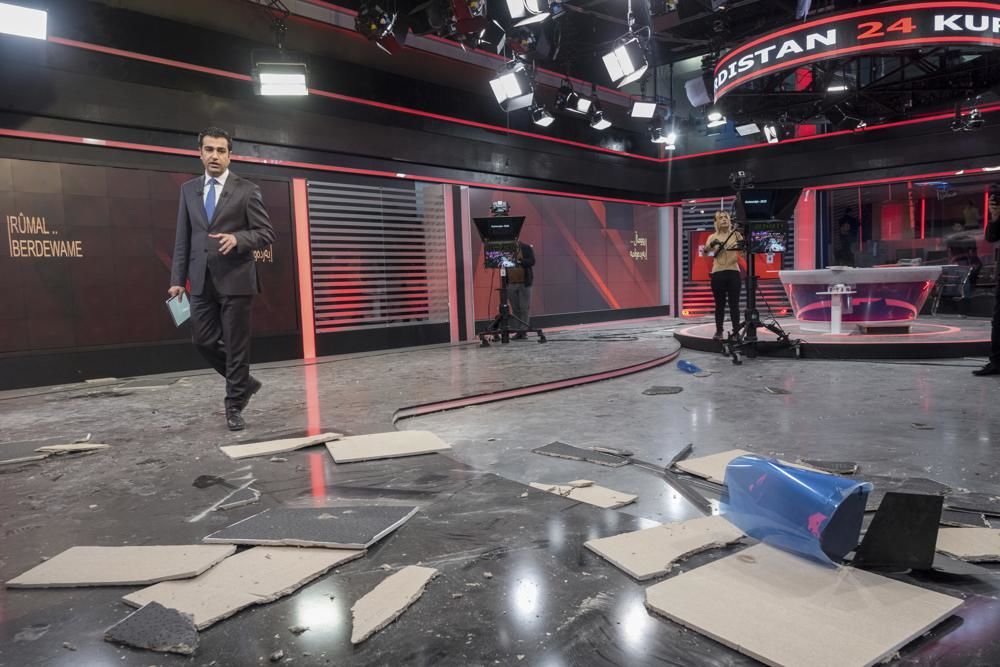 Employees of Kurdistan 24, a satellite television station, work in a
studio damaged by an Iranian ballistic missile attack in Irbil, Iraq,
Sunday, March 23, 2022.
Employees of Kurdistan 24, a satellite television station, work in a
studio damaged by an Iranian ballistic missile attack in Irbil, Iraq,
Sunday, March 23, 2022.
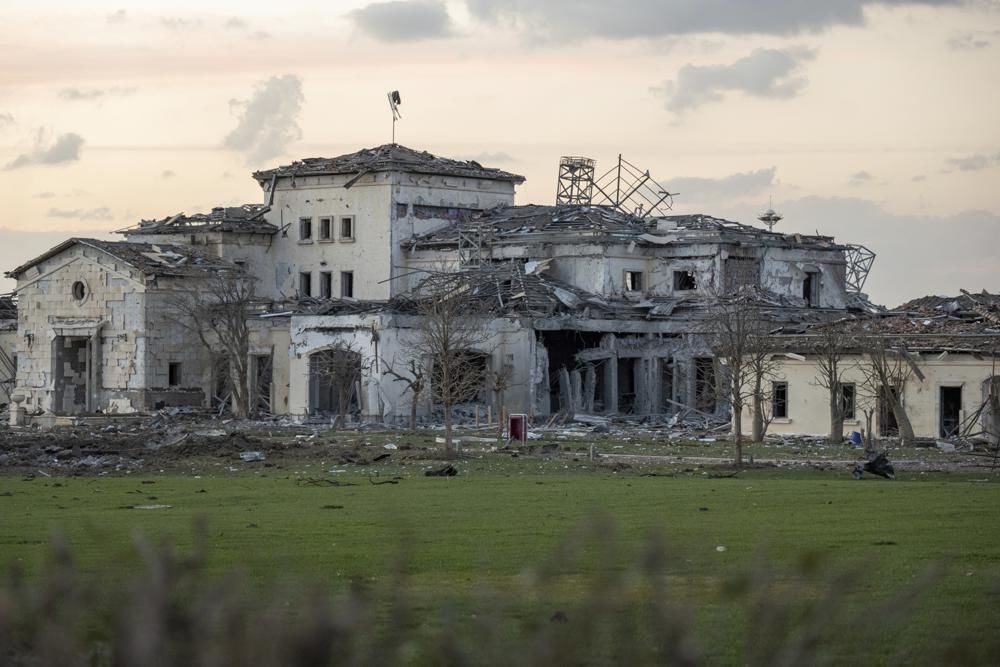 A house damaged by an Iranian ballistic missile attack is seen in Irbil,
Iraq, Sunday, March 23, 2022. Iran has claimed responsibility for a
missile barrage that struck early Sunday near a sprawling U.S. consulate
complex in the northern Iraqi city of Irbil, saying it was retaliation
for an Israeli strike in Syria that killed two members of its
Revolutionary Guard.
A house damaged by an Iranian ballistic missile attack is seen in Irbil,
Iraq, Sunday, March 23, 2022. Iran has claimed responsibility for a
missile barrage that struck early Sunday near a sprawling U.S. consulate
complex in the northern Iraqi city of Irbil, saying it was retaliation
for an Israeli strike in Syria that killed two members of its
Revolutionary Guard.
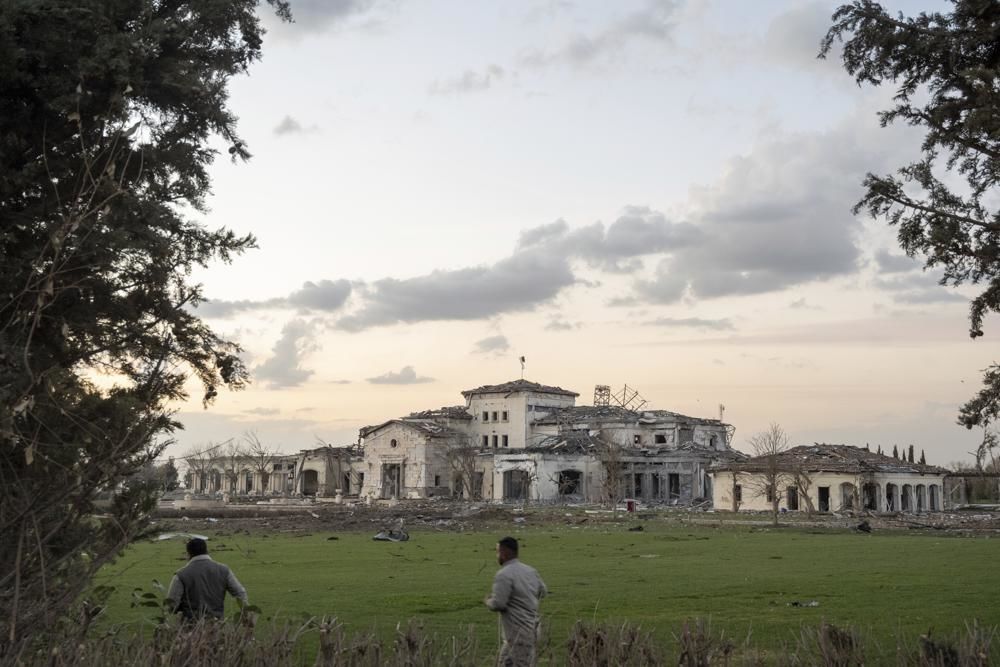 People walk by a house damaged by an Iranian ballistic missile attack in
Irbil, Iraq, Sunday, March 23, 2022. Iran has claimed responsibility
for a missile barrage that struck early Sunday near a sprawling U.S.
consulate complex in the northern Iraqi city of Irbil, saying it was
retaliation for an Israeli strike in Syria that killed two members of
its Revolutionary Guard.
People walk by a house damaged by an Iranian ballistic missile attack in
Irbil, Iraq, Sunday, March 23, 2022. Iran has claimed responsibility
for a missile barrage that struck early Sunday near a sprawling U.S.
consulate complex in the northern Iraqi city of Irbil, saying it was
retaliation for an Israeli strike in Syria that killed two members of
its Revolutionary Guard.
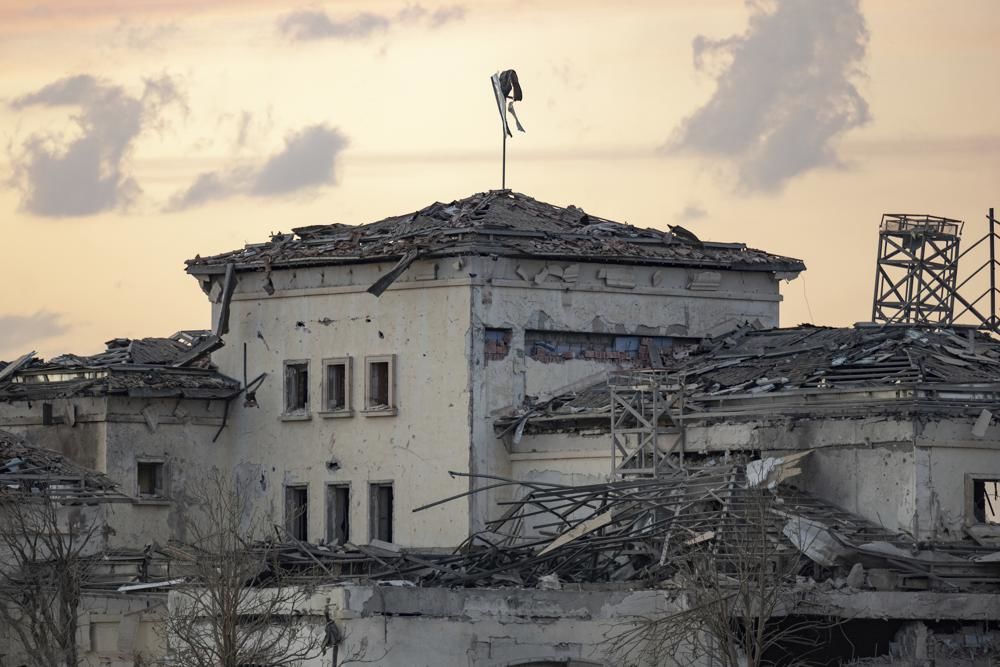 A house damaged by an Iranian ballistic missile attack is seen in Irbil,
Iraq, Sunday, March 23, 2022. Iran has claimed responsibility for a
missile barrage that struck early Sunday near a sprawling U.S. consulate
complex in the northern Iraqi city of Irbil, saying it was retaliation
for an Israeli strike in Syria that killed two members of its
Revolutionary Guard.
A house damaged by an Iranian ballistic missile attack is seen in Irbil,
Iraq, Sunday, March 23, 2022. Iran has claimed responsibility for a
missile barrage that struck early Sunday near a sprawling U.S. consulate
complex in the northern Iraqi city of Irbil, saying it was retaliation
for an Israeli strike in Syria that killed two members of its
Revolutionary Guard.