

Lebanese opposition election candidates face threats and attacks
Hicham Hayek knew supporters of Lebanon’s traditional political parties would oppose his parliamentary election campaign in southern Lebanese village of Sarafand, but he did not expect that he, his running mates and attendees would be beaten, with the Lebanese army having to escort them to safety.
Hayek, a medical surgeon running in the May 15 election under the slate Together For Change, told Al Jazeera that supporters of Hezbollah and its ally the Amal Movement had beaten up workers at the venue before he arrived for the event on April 16.
“And as we approached the venue we saw that they had closed off the road leading to the event with tires, and they were yelling at people, attacking them and insulting them,” he said.
Southern Lebanon is a key political bastion for Iran-backed Hezbollah and Amal Movement, whose leader Nabih Berri has been speaker of parliament since 1992.
“They threw rocks at us, and told us: ‘This is Nabih Berri’s territory’,” Soltan al-Hosseini, a student activist that supports Hayek.
“They accused us of being foreign agents.”
The candidates and supporters who made it inside the venue tried to hold the event, but more angry people showed up.
“Some people tried to reason with [them], and asked them to open the road, but they were only beaten up,” Hayek said. “Then one of them took out a handgun and fired towards us.”
The army escorted Hayek and the others outside to leave safely, while those in the venue had to leave by driving on a dirt road to make it out of the area.
Amal Movement, in a statement soon after the incident, denied their involvement.
The army has arrested a man accused of shooting at the group, after activist lawyers fired a legal complaint. However, Amal supporters have demonstrated for his release by blocking a highway in the southern town with large piles of dirt and burning tyres.
Meanwhile in Beirut, opposition candidates say they face what they have called systematic attacks before the parliamentary election.
Independent legislator and former broadcast journalist Paula Yacoubian is running for another term in parliament after being elected in 2018. She said that five of her campaign billboards were vandalised in the capital’s Achrafieh district.
She filed a legal complaint, and believes traditional political parties have orchestrated the vandalism to intimidate her and her allies.
“State Security are investigating the matter and they told me there was a suspect, but is now missing,” Yacoubian told Al Jazeera.
“If the suspect was some ordinary person, we have known who it was by now … this shows that this was organised work.”
Yacoubian’s friends and supporters promoting her campaign online are reportedly receiving phone calls, pressuring them to stop.
“They’re following friends, people I know, and others who visit me,” she said. “They get calls from people threatening their livelihoods, telling them ‘Don’t you know we have employed this person, you know?’”
This kind of targeting in Beirut is “unprecedented”, she said. “They’re now going after people one by one.”
Growing discontent
In October 2019, anti-government protests swept across Lebanon, as protesters raged against the country’s governing elite and their private-sector cronies.
The country’s economy has since spiralled, leaving more than three-quarters of the population in poverty, while the free-falling Lebanese pound has caused a surge in food and fuel inflation.
Opposition groups have grown in size as a growing number of the country’s disgruntled population are losing faith in the political and economic status quo.
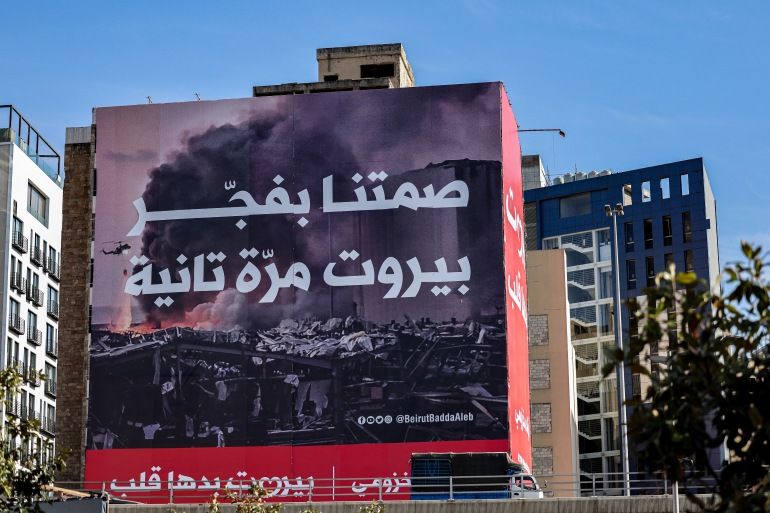 A truck drives past a billboard for the upcoming parliamentary election
A short drive away from where Yacoubian is campaigning, candidates and volunteers with the electoral campaign group Beirut Tuqawem (Beirut Resists) set up a tent to hold public discussions with residents in Tarik Jdideh in March. It started smoothly.
“Some people from the surrounding shops had back and forth discussions with us about what they think should be prioritised and what should be in our programme, and wanted to know more about who’s running with us,” Dima Ayyach, a coordinator with the opposition group, told Al Jazeera. “It was a fruitful discussion.”
But then, she said an irate group of men approached the candidates.
“They said it was Hariri’s area, we shouldn’t be here, and that we should leave before things escalate,” Ayyach said – referring to Saad Hariri, former Lebanese prime minister and head of the Saudi-backed Future Movement, who stepped down from politics earlier this year.
The alleged Future Movement supporters were not willing to talk things out with Beirut Tuqawem. They took down the campaign’s tent and kicked the opposition group out.
While anti-establishment sentiment across Lebanon is nowhere near as boisterous as in late 2019, where hundreds of thousands took to the streets and rocked the country, living conditions continue to worsen.
Opposition groups tell Al Jazeera that many voters are far more open to meeting them, and discussing their platforms and goals, and believe this is why they have faced threats and attacks.
“We’re taking on the elections for the people, who are all being humiliated at the banks, the gas stations, and the bakeries,” Hayek said.
“I ask those who attacked us and shot at us, are they being paid well? Are they able to fill their cars with fuel or find bread at the bakery? Aren’t their kids also leaving the country? And didn’t they lose any relatives in the Beirut Port blast?”