

‘Mercenaries have skills armies lack’: former Wagner operative opens up
Sitting in a cafe in an upmarket Moscow suburb, the former mercenary Marat Gabidullin looked a long way from the battlefields of Syria where he fought half a decade ago.
Gripping his recently finished memoir, In the Same River Twice, the first published account of fighting for the secretive Russian mercenary outfit Wagner, Gabidullin said: “I wrote this because I realised it’s time for our country to face the truth: mercenaries exist.”
At 55, he’s an imposing figure, with his face and muscular arms covered in scars. “We, in Russia, prefer not to discuss our mercenaries,” he added. “It doesn’t fit the official narrative.”
In 2015, Gabidullin, a Russian airborne forces veteran and former bodyguard, joined Wagner, at the time a relatively unknown mercenary group. He was soon deployed to fight in Syria alongside the Russian army supporting President Bashar al-Assad, quickly rising to command one of Wagner’s five units there.
Established in 2014 to support pro-Russian separatists in eastern Ukraine, Wagner is allegedly funded by Yevgeny Prigozhin, a powerful businessman closely linked to Vladimir Putin who has faced western sanctions.
From the company’s inception, it has been shrouded in mystery. On paper, the firm does not exist, with no company registration, tax returns or organisational chart to be found.
Western governments and academics argue that Wagner is an unofficial foreign policy tool of the Kremlin, deployed where Russia wants to extend its influence or create upheaval. Prigozhin and Moscow have denied any knowledge of Wagner; officially, private military companies remain illegal in Russia. Representatives for Prigozhin have not responded to requests for comment.
Gabidullin made no attempt to deny Wagner’s existence or its active role in Russian security interests. In contrast, he said one of his main motivations behind writing the book was to bring mercenary companies such as Wagner “out of the shadow”, highlighting their potential benefits for Russia’s foreign policy goals.
“Mercenary groups are nothing to be ashamed of, they exist everywhere, but we lie about them,” he said. “We have specialised skills that a normal army lacks.”
The memoir, based on events Gabidullin claims he witnessed, follows three years of Wagner’s Syrian campaign. It describes some of the mercenaries’ big battles, including two operations to liberate the ancient city of Palmyra. Scores of Wagner soldiers are believed to have fought and died in Syria since the conflict began in 2011.
 The ancient ruins of Palmyra in Syria after intense battles in 2016 in which Wagner is said to have taken part.
“The Russian army’s achievements in Syria were largely because of the mercenaries’ sacrifices. That fact is completely ignored by the military establishment and not known to the wider public,” Gabidullin complained, grumbling that “mediocre” Russian army generals received promotions based on Wagner’s successes.
The memoir also describes mercenaries’ day-to-day lives, including occasional looting, and his commanders’ missteps.
Gabidullin, whose hearing has suffered after years of fighting, also said he participated in the 2018 Battle of Khasham, where hundreds of Russian mercenaries were reportedly killed after US airstrikes against pro-regime forces, in what is believed to be the deadliest clash between Russia and the US since the cold war.
“We should never have been there; our leadership messed up. The Americans knew exactly where we were,” he said, recalling those events.
Post-Syria, Wagner’s notoriety has increased after reported operations in Central African Republic and Libya – resource-rich countries in which Russia has strategic interests. The group’s growing influence has also divided Mali and its European partners after the west African nation deployed Wagner fighters in December.
And as tensions have escalated over Ukraine in recent months, Reuters reported that unnamed Russian mercenaries have been sent to separatist-controlled eastern Ukraine. Last week, the US-based Daily Beast claimed that Wagner soldiers are being moved from Africa, possibly towards Ukraine.
Gabidullin said he had “vaguely heard” of mercenary deployments in Ukraine, quickly adding that a Russian invasion would be a “fatal” mistake. “I believe that war between Ukraine and Russia will be a complete disaster for Russia. Under no circumstances should this be allowed. Ukraine is our brother.”
Throughout the conversation, Gabidullin looked somewhat agitated, his piercing blue eyes darting around the empty cafe. He said he worried about the consequences of publishing his book and was eager to avoid mentioning his alleged former boss, Prigozhin.
“I suspect that there will be attempts by [Prigozhin] to discredit me. I am walking on a tightrope here,” he said.
He first wanted to publish the memoir in 2020 but quickly withdrew his book after pressure from “certain people”. This time, however, he decided to not hold back and found a “brave” publisher in the city of Ekaterinburg. The Paris-based Michel Lafon publishing house is also planning to distribute a French version.
“I thought to myself, ‘Enough, it’s time to get out of the shadows.’ I will not be dissuaded from publishing again. Because it is not just about me,” said Gabidullin.
He pointed to how the ban on private military companies in Russia pressures family members of deceased mercenaries to remain quiet about their loved ones. Gabidullin hopes his book will help lift the veil of secrecy around his former profession.
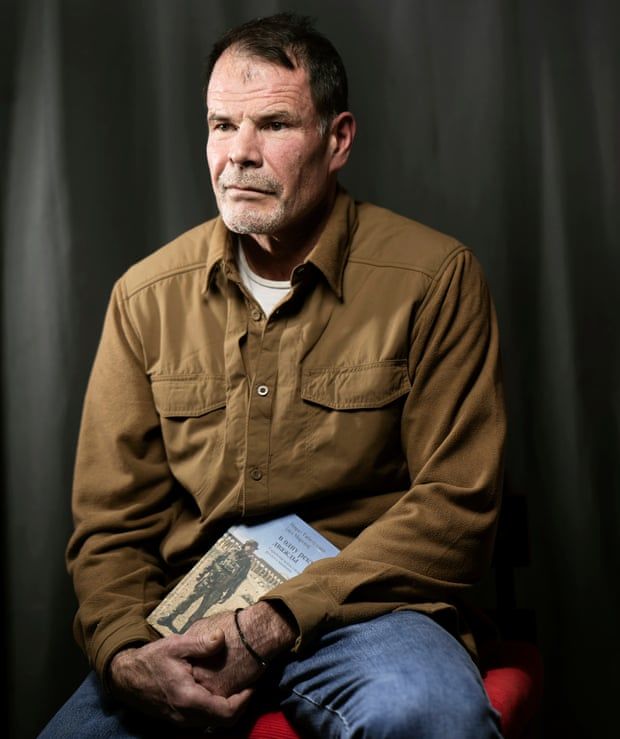 Marat Gabidullin holding his memoir, In the Same River Twice.
“This current situation does not suit many of my comrades. More importantly, it does not suit the dead mercenaries’ parents and relatives, who cannot even talk openly about how their son or brother died. They can only whisper it.”
While Gabidullin’s memoir challenges the official narrative regarding the existence of mercenaries in Russia, a separate PR campaign also sprung up last year to promote the activities of groups like Wagner.
Russian state television recently screened numerous patriotic action movies produced by Prigozhin-linked firms, depicting unnamed Russian “military instructors and volunteers” fighting in eastern Ukraine, Central African Republic and Mozambique – places where Wagner fighters have reportedly been active.
The films, which Gabidullin dismissed as “trash”, portray heroic Russians saving local people from violent rebels. They stand in stark contrast to recent UN reports accusing Wagner operatives of raping civilians in Central African Republic or allegations that Wagner soldiers tortured and killed a prisoner in Syria.
Confronted with these accusations, Gabidullin said he never saw his comrades engaged in such acts but added that such crimes were to be expected given the group’s current shadowy status. “The state puts mercenaries in a situation where they can act outside the law, and a soldier is forced to establish his own moral norms. But, of course, we should investigate that messed-up stuff.”