

‘Miracle’ baby born in the rubble as her mother died beside her
In the afternoon of that day when a series of earthquakes ripped through Turkey and Syria, Dr Hany Maarouf, 43, returned to his duties at the Jehan Hospital in Afrin, in Syria’s northwest, having made sure his wife and seven children were safe.
At about 3pm, a man and woman ran in, the man holding in his arms a small bundle, shouting that they needed a paediatrician. Their faces showed panic that had turned to despair. This was the sixth hospital they had run to with their precious bundle – baby Aya, who had just been born in the rubble of a collapsed building to a mother who had died.
A miracle in the rubble
Assuring them that he was a paediatrician, Maarouf gently took the baby from them but what he saw “terrified” him.
“I wasn’t sure she was even alive – she was pale, cold, silent. Her limbs were blue and her body was covered with bruises,” he recalled.
Then a faint pulse was discovered and he and his team sprang into action. They wrapped the baby with warmed blankets and placed her in an incubator, watching her until she warmed up enough that they were able to find a vein to hook her up to calcium and glucose solutions.
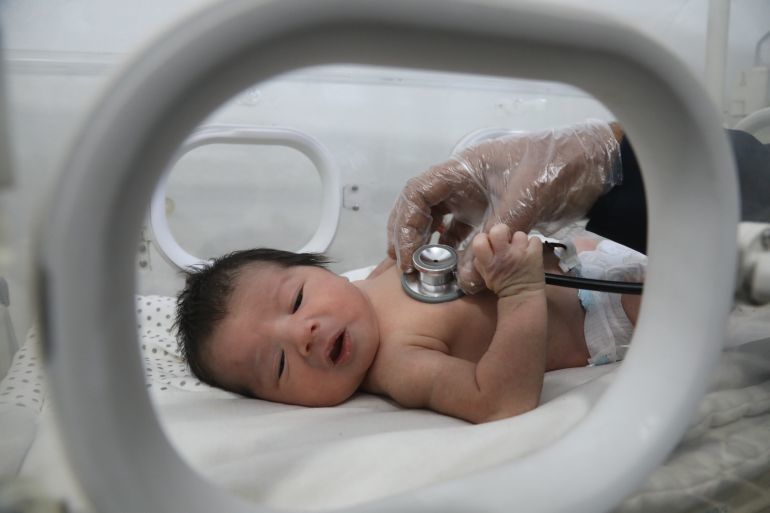 Baby Aya is not a fan of the stethoscope, but it helps the doctors determine that she is doing just fine
The man who had brought her in – her aunt’s husband – and the woman who accompanied him – a neighbour – were relieved that Aya was going to be saved, but the cruel reality of that day meant they could not stay any longer by her side as they had to go find their own families, and possibly count and bury their dead.
Four days after baby Aya was first brought in and named by the hospital staff, Maarouf tells Al Jazeera that she is doing much better and that the hospital team has pulled together to make sure she is well taken care of. Although she still spends the day in an incubator, baby Aya is being breastfed by a volunteer who comes in several times a day, which provides her with the human, skin-to-skin contact babies need to thrive, in addition to the antibodies and nutrients that can only be found in human breast-milk.
And she has thrived, Maarouf says proudly, adding that she is putting on weight, showing all the positive indicators and all-around doing much better than he had expected. While he, as a father of seven, often finds himself too deeply moved by the baby’s plight to spend too much time at her side, many of the nursing staff visit her, sitting by her incubator and watching her sleep or coo and wave her arms.
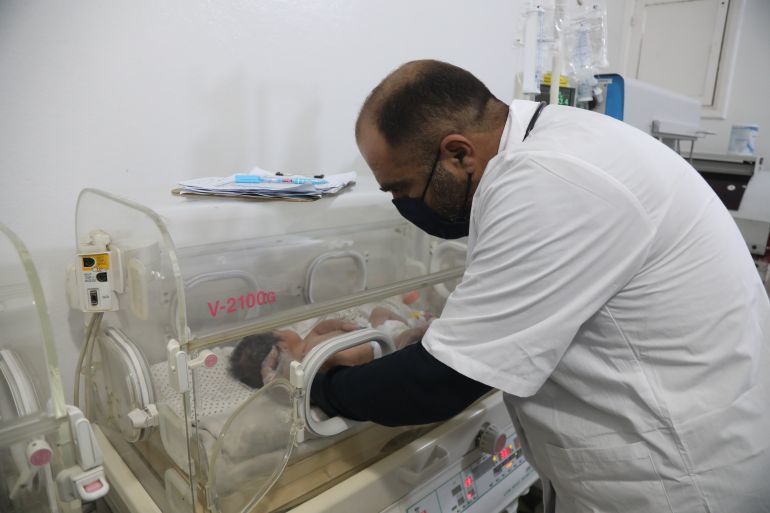 Dr Maarouf is proud of how much Aya has thrived but, as a father of seven, he is deeply saddened by her plight
The circumstances of baby Aya’s mother going into labour remain undetermined, but Maarouf says it is very possible for a woman to go into labour due to shock and for the labour to continue to its end regardless. That the rescuers on Monday heard baby Aya’s cries in the rubble and were able to remove her and get her to help within hours was “first and foremost due to God’s mercy”, Maarouf says.
Surprisingly, he adds, it was possible that the extreme cold complicating rescue efforts had played a role in keeping baby Aya alive until she was found. Because of the cold, she went into hypothermia, which is actually a therapy used in neonatal hospitals to save babies whose brains lack oxygen at birth. This would have preserved her brain function until the hospital staff were able to warm her up and start her care.
‘We’ll stay open, no matter what’
When Maarouf reassured baby Aya’s relatives that they would take care of the baby and that they should go check on the rest of their families, he was speaking with the full knowledge of the horror that had struck Afrin that day. And what war-ravaged Syria has been going through for the past 12 years, as he himself was displaced from Maaret al-Naaman to Afrin in 2019.
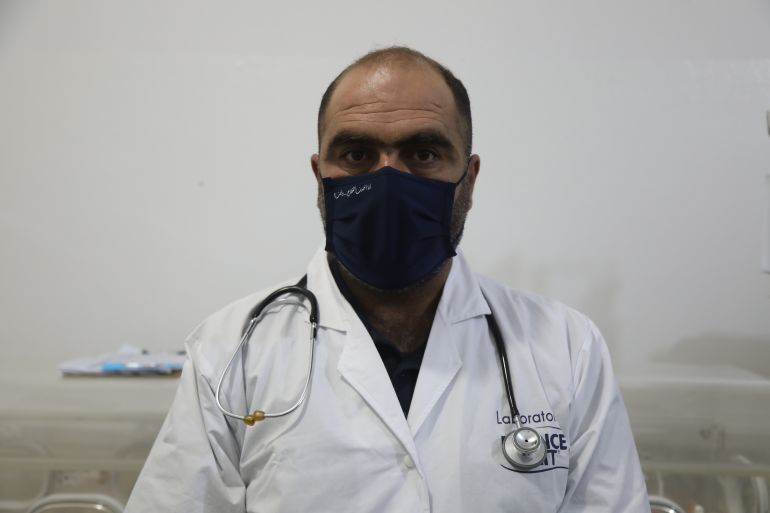 Dr Maarouf and his family were displaced from Maaret al-Naaman to Afrin in 2019
He had spent hours in the car with his wife and children on the day of the earthquakes until their house was deemed safe to go back into, and that day they had 40 people sheltering with them because they had nowhere else to go. It was that thought that pushed him to go back to work that day, that someone might need help.
“Us paediatricians, we’re not the heroes of these disasters, not by a long shot,” he told Al Jazeera. “The true heroes are the surgeons, the civil defence people who are literally saving lives every minute under the most horrible circumstances.
“This is not the first disaster to strike this region, God knows, we’ve had years of bombardment and war. Throughout that time, we are the second line of defence, we usually take care of children who need regular care, who have pre-existing conditions, who still need our care even as walls come falling down. That’s why I said that we would not close the hospital, we would stay open, no matter what.”
Even that was difficult in the first days after the quakes, which have killed more than 21,500 people to date. “The pharmacies closed, the medical depots closed, everything stopped. We were spinning in circles because we don’t have many medicines on hand in the hospital dispensary,” Maarouf said.
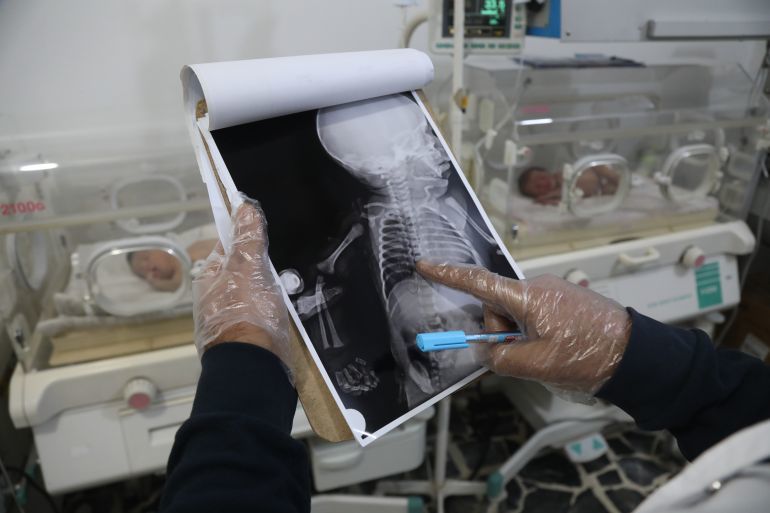 The team ran all the necessary checks and were amazed at how well Aya had come through her ordeal
“One of the days, we needed a bit of formula for baby Aya because the volunteer hadn’t come in yet to nurse her. I was at my wit’s end until I remembered that I had a couple of small samples of formula somewhere in my office, so that situation was saved. Now, things are a little better, maybe at 50 percent.
“But that’s still not good enough. Look at how long we’ve been waiting for any kind of assistance! The border crossings are closed they said, those organisations and the UN. So they all can’t find a helicopter to fly aid into here?”
The northwestern part of Syria is held by forces opposed to President Bashar al-Assad in the country’s 12-year war. It is largely isolated, with only one approved land border crossing used to bring assistance via Turkey to its more than four million residents, most of whom are internally displaced.
No aid crossed the Bab al-Hawa crossing for three days after the earthquake due to extensive road damage in Turkey, but convoys resumed coming through on Thursday. The needs, however, remain enormous, with the World Food Programme warning on Friday it was running out of stock in northwest Syria and appealing for more corridors to be opened.
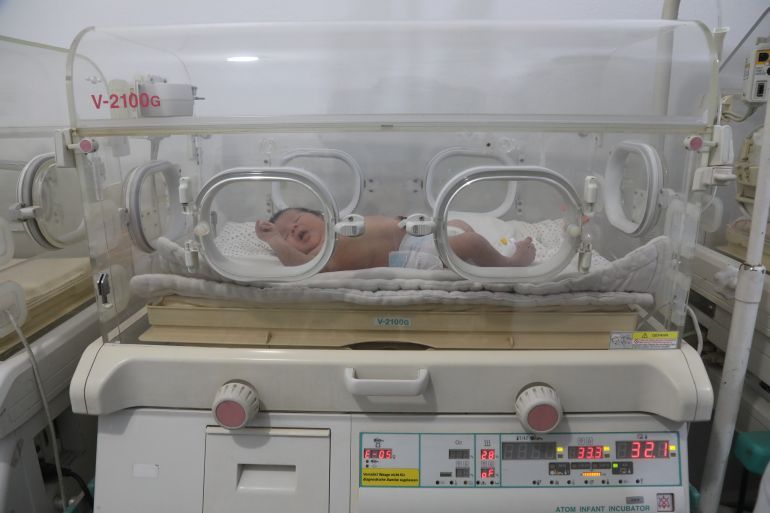 Many of the nursing staff visit Aya, sitting by her incubator to watch her sleep or coo and wave her arms
In spite of the anger and sadness at the situation, or perhaps because of an inner resilience that has been built up over years of successive disaster for the region, he speaks in a remarkably calm voice and with a deep empathy for what everyone around him is going through.
Her aunt’s husband has come to visit baby Aya since, but it does not seem like the family is in any condition to come to take her in just yet, Maarouf said. And that is just fine with him, all the folks at Jehan Hospital are happy tending to baby Aya for as long as it takes.