

NGOs voice fears for Syrians over limited UN aid mandate
While there is temporary relief for millions of displaced Syrians as a crucial UN aid operation from Turkey to northwest Syria has resumed, aid workers and rights groups have warned that the timeframe will put people at risk of hunger, homelessness, and disease during the coldest months of the year.
The United Nations Security Council passed a resolution on Tuesday to resume aid deliveries through the Bab al-Hawa border crossing to four million people in the last rebel-held area of Syria, but only for six months as Russia has demanded.
A broader resolution, first adopted in 2014, had allowed UN agencies to reach beleaguered civilians from four land crossings – one in Iraq, one in Jordan and two from Turkey – without the permission of Syrian President Bashar al-Assad. But along with China, the Kremlin has used its veto to reduce the number of UN crossings over the last two years.
Bab al-Hawa, the last remaining crossing, had closed on Sunday after Russia – an ally of al-Bashar – rejected a proposal to renew the resolution for one year.
Aid groups told Al Jazeera that UN and Western donor countries need to prepare a viable contingency plan in case the cross-border resolution is not renewed again as they could only cover a fraction of the relief that UN agencies provide to northwest Syria.
They said a failure to renew the operation in winter would also compound a likely rise in hunger, homeless and deaths from treatable diseases.
“Due to the sheer scale of aid that is provided by the UN through this [cross-border] mechanism it will be impossible for NGOs … to completely cover the gaps that [would] be created,” Elias Abu Ata, the Communications Manager for the International Rescue Committee (IRC), told Al Jazeera.
Unemployment could also spike since local NGOs would be forced to close down or scale back operations after losing UN donor assistance. Since 2014, Syrian relief groups have benefitted from the Syrian Cross Border Humanitarian Fund (SCHF), which UN agencies are tasked with allocating under the cross-border resolution.
Last year, the SCHF financed 31 NGOs and 53 projects.
“We work with five UN agencies and they fund about 80 percent of our programmes,” said Yakzan Shishakly, CEO of the Maram Foundation for Relief and Development, which provides housing assistance and education to Syrians in need.
“If the funding ever stops, we’ll need to lay people off until we find new donors … but 80 percent of our colleagues are refugees or [internally displaced persons]. We would be cutting livelihoods and funds from their families.”
The United States, the United Kingdom and France – which abstained from the UN Security Council vote on Tuesday – have also said that six months does not provide enough time for aid groups to operate effectively.
Mark Cutts, the UN deputy regional humanitarian coordinator, also said that civilians must not be deprived of cross-border aid in Syria.
“Conflict-affected civilians must continue to have safe access to humanitarian assistance for as long as it’s needed, on both sides of the front-line,” he tweeted.
For years, UN agencies have told NGOs that they will not abandon Syrians in the northwest. Despite the assurances, aid groups fear that the UN has no alternative plan in place to maintain its funding if the resolution expires for good.
Abu Ata cited the massive gap that UN agencies left behind after the al-Yarubiyah border – the crossing from Iraq that leads to northeast Syria – was closed in January 2020. Shortly after, Western diplomats said that medical aid declined by about 40 percent to the region.
“We learned the hard way from the loss of al-Yarubiyah that the UN will not continue key aspects of its support to the cross-border response in the event of a non-reauthorisation,” Abu Ata said.
“[That includes] the loss of major amounts of direct funding to NGOs, administrative mechanisms for pooled funding, the delivery of supplies and goods across the border and the UN’s critical coordination and oversight mechanisms.”
Al Jazeera contacted Jens Laerke, the deputy spokesperson for the UN Office for the Coordination of Humanitarian Affairs (UNOCHA), but he could not be reached for comment.
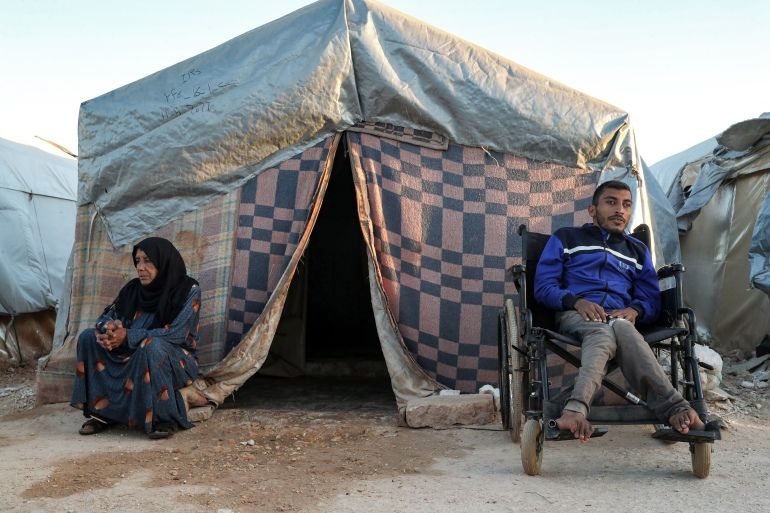 A camp for displaced Syrians in the rebel-held northwestern Idlib province
Russia has long called for the replacement of cross-border aid with relief coming from the capital of Damascus – a concept known as cross-line aid within the NGO community. But last year, only 70 truckloads of aid came via cross-line compared with the 800 trucks that reached the region from Turkey.
“[Cross-line aid] is in no way an alternative. It’s a drop in the ocean,” Hiba Zayadin, the Syria researcher for Human Rights Watch (HRW), told Al Jazeera.
“Concerned governments should explore other ways to ensure that sufficient life-saving aid can reach all Syrians in need,” said her colleague Louis Charbonneau, the UN advocate for HRW.
Shishakly said that the Syrian government cannot be trusted with impartially coordinating humanitarian operations to an area under rebel control, and al-Assad has diverted aid to reward his supporters and to fund reconstruction efforts – effectively circumventing western sanctions.
“If we leave humanitarian coordination up to the government, then [NGOs] are screwed,” Shishakly told Al Jazeera. “They don’t give us approval to areas where they don’t want civilians to have access to aid.”
Zayadin said that the UN Security Council needs to consider alternatives to the resolution and that regularly advocating for the renewal of the cross-border mechanism drains resources that could go to other work.
“It is always a precarious situation every time this mechanism comes up for renewal every year, and the fact that [aid agencies] don’t know if it will continue makes it difficult to plan ahead,” she said.