Arab Press

بالشعب و للشعب
Sunday, Jul 12, 2026

Planet Earth: 8 billion humans and dwindling resources

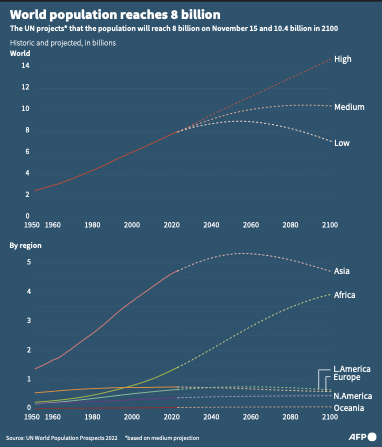
Are eight billion humans too many for planet Earth? As we reach this milestone on November 15, most experts say the bigger problem is the over-consumption of resources by the wealthiest residents.

“Eight billion people, it is a momentous milestone for humanity,” said United Nations Population Fund chief Natalia Kanem, hailing an increase in life expectancy and fewer maternal and child deaths.

“Yet, I realize this moment might not be celebrated by all. Some express concerns that our world is overpopulated. I am here to say clearly that the sheer number of human lives is not a cause for fear.”

So, are there too many of us for Earth to sustain?


Many experts say that this is the wrong question. Instead of the fear of overpopulation, we should focus on the over-consumption of the planet’s resources by the wealthiest among us.

“Too many for whom, too many for what? If you ask me, am I too many? I don’t think so,” Joel Cohen of Rockefeller University’s Laboratory of Populations told AFP.

He said the question of how many people Earth can support has two sides: natural limits and human choices.

'We are stupid and greedy'

Our choices result in humans consuming far more biological resources, such as forests and land, than the planet can regenerate each year.

The overconsumption of fossil fuels, for example, leads to more carbon dioxide emissions, responsible for global warming.

We would need the biocapacity of 1.75 Earths to sustainably meet the needs of the current population, according to the Global Footprint Network and WWF NGOs.

The most recent UN climate report mentions population growth as one of the main drivers of an increase in greenhouse gases. However, it plays a smaller role than economic growth.

“We are stupid. We lacked foresight. We are greedy. We don’t use the information we have. That’s where the choices and the problems lie,” said Cohen.
However, he rejects the idea that humans are a curse on the planet, saying people should be given better choices.

“Our impact on the planet is driven far more by our behavior than by our numbers,” said Jennifer Sciubba, a researcher at the Wilson Center, a think tank.

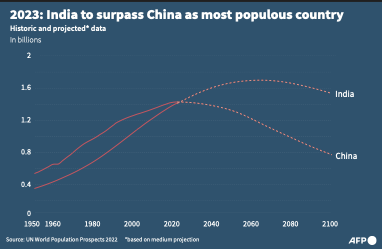
“It’s lazy and damaging to keep going back to overpopulation,” she added, as this allows people in wealthy nations, who consume the most, to cast the blame for the planet’s woes onto developing countries where population growth is highest.

“Really, it’s us. It’s me and you, the air conditioning I enjoy, the pool I have outside, and the meat I eat at night that causes so much more damage.”

If everyone on the planet lived like a citizen of India, we would only need the capacity of 0.8 Earths a year, according to the Global Footprint Network and WWF. If we all consumed like a resident of the United States, we would need five Earths a year.

The United Nations estimates that our planet will be home to 9.7 billion people by 2050.

Protecting women's rights


One of the trickiest questions that arise when discussing population is that of controlling fertility. Even those who believe we need to lower the Earth’s population are adamant about protecting women’s rights.

Robin Maynard, the executive director of the NGO Population Matters, says there needs to be a decrease in the population, but “only through positive, voluntary, rights-respecting means” and not “deplorable examples” of population control.

The NGO Project Drawdown lists education and family planning among the top 100 solutions to halt global warming.


“A smaller population with sustainable levels of consumption would reduce demands on energy, transportation, materials, food, and natural systems.”

Vanessa Perez of the World Resources Institute agrees that “every person that is born on the planet puts additional stress on the planet.”

“It is a very thorny issue,” she said, adding that we should reject “this idea that the elite capture this narrative and say we need to cap population growth in the South.”

She believes the most interesting debate is not about the number of people but “distribution and equity.”

Cohen points out that even if we currently produce enough food for 8 billion people, there are still 800 million people who are “chronically undernourished.”

“The concept of ‘too many’ avoids the much more difficult problem, which is: are we using what we know to make the human beings we have as healthy, productive, happy, peaceful, and prosperous as we could?“

Comments

Oh ya 4 year ago
Not to worry, those that took the de population clot shot will most likely be gone in the next couple of years just as the devil bill gates said in his Ted talk. Already funeral homes and insurance companies are saying that above normal deaths are up 20% among 18-49 year olds

Newsletter

Related Articles

Arab Press
0:00
0:00
Close
The AI Invoice Shock: Layoffs Didn't Save Managers Money — They Cost Them More
Concern: Sexually Transmitted Bacterium Among Men Develops Antibiotic Resistance
Passenger Partially Pulled Out of Ryanair Jet After Cabin Window Fails Mid-Flight
Severe Heatwave Drives Dangerous Ground-Level Ozone Pollution Across Two Thirds of European Union
The Physical and Electronic Barriers Disrupting Domestic Wireless Networks
France and Morocco Open World Cup Quarter-Finals as Collina Defends Refereeing
Tech Pulse: The Future of AI and Screen Culture
Global News Briefing: Escalating Geopolitical Tensions and Corporate Shakeups
Global News Brief: Escalating Conflicts, Public Health Crises, and World Cup Drama
Europe's Growing Struggle with Extreme Heat and Air Conditioning
Anthropic Reengineers Agentic Architecture to Shift Autonomous Workplace Automation to the Cloud
Logic Flaw in Windows 11 Permission Architecture Silently Consumes Hundreds of Gigabytes of Local Storage
Apple Advances Late-Stage Operating Systems with Fourth Beta Deployments
Global Crisis Alert: Escalating Middle East Tensions and UK Political Upheaval
Japanese Technology Firm Fujitsu Launches Advanced Artificial Intelligence Tool for Corporate Disclosures
South Africa Officially Launches Nationwide Campaign for Highly Contested Local Government Elections
United Kingdom Commits Additional Funding for Unexploded Ordnance Clearance in Laos
Singapore Announces Stringent New Greenhouse Gas Regulations for Commercial Cooling Systems
Cambodia and Thailand Hold High-Level Border Security Talks at United Nations Headquarters
Myanmar Military Government and China Sign Major Agreement to Upgrade Media and Cultural Cooperation
Knife Attack at Swiss Train Station Leaves Three Injured in Suspected Act of Domestic Terrorism
Transnational Extortion Gang Threatens Canadian Police With Army of One Thousand Armed Operatives
Australia Imposes Forty-Two-Day Quarantine on Cruise Ship Passengers Following Deadly Hantavirus Outbreak
International Monetary Fund Unlocks Seven Hundred Million United States Dollars for Sri Lanka Following Economic Reforms
Australia Launches Record One Point Four Billion Dollar Lawsuit Against Chemical Giant 3M Over Contamination
China and Canada Foreign Ministers Meet in Ottawa in Effort to Stabilize Strained Diplomatic Ties
Indonesia Demands Urgent United Nations Security Council Reform Amid Escalating Global Conflicts
Extreme Weather Patterns Trigger Severe Drought in Madagascar and Destructive Flooding in East Africa
Indian State of Karnataka Faces Political Upheaval as Chief Minister Siddaramaiah Abruptly Resigns
Philippines and Japan Reaffirm Defense Ties as Crucial for Indo-Pacific Regional Stability
Norway Joins French Nuclear Deterrence Initiative in Major Shift for European Security Architecture
Global Critical Mineral Alliances Expand as Western Nations Move to Counter Chinese Supply Dominance
United States Imposes Fifty Percent Tariffs on Mexican Steel and Aluminum Ahead of Trade Pact Review
European Union and China Head Toward Major Trade Conflict Over Clean Technology Exports
United States Economic Growth Severely Downgraded to One Point Six Percent as Stagflation Fears Mount
World Health Organization Warns Central African Ebola Epidemic is Outpacing Containment Efforts
United States Treasury Department Conditions Sanctions Relief on Reopening of the Strait of Hormuz
Iranian Air Defenses Intercept and Destroy United States Military Drone Over Bushehr Province
Iranian Armed Forces Launch Ballistic Missiles Toward Unspecified Targets Prompting Regional Condemnation
United Nations Secretary-General Warns Global Order Facing Highest Level of Conflict Since 1945
Israel Issues Sweeping Evacuation Orders in Southern Lebanon Amid Intensified Hezbollah Conflict
Russia Announces Systemic Military Strikes Targeting Ukrainian Defense and Energy Infrastructure
United States and Iranian Negotiators Reach Draft Agreement to Extend Ceasefire and Resume Nuclear Talks
United Nations Security Council Deeply Divided Over United States Capture of Venezuelan President
US and Iran Exchange Direct Military Strikes Amid Fragile Gulf Ceasefire
World Health Organization Warns of Catastrophic Ebola Outbreak in DR Congo
Russia Threatens New Wave of Strikes on Ukrainian Infrastructure and Embassies
Scientists Warn Atlantic Ocean Currents Could Collapse Faster Than Projected
Anthropic Reaches $900 Billion Valuation in Historic AI Funding Round
Washington Imposes Crippling Sanctions on Iranian Maritime Authority
×