Arab Press

بالشعب و للشعب
Friday, Jan 23, 2026

Syria’s $1.5bn seizure of protesters’ property ‘akin to scare tactic’

Syria’s $1.5bn seizure of protesters’ property ‘akin to scare tactic’

Human rights group accuses Assad regime of profiting from detainees forced to sign away their rights, some while blindfolded

More than $1.5bn (£1.2bn) worth of personal property including cars, olive groves, shops, houses, electronics and jewellery has been seized by the Syrian government from citizens accused of joining anti-government protests, according to a rights group.

The Association of Detainees and the Missing in Sednaya Prison (ADMSP) estimates that almost 40% of those detained after the Syrian uprising of 2011 were subject to property seizures.

It alleges the Syrian regime has attempted to circumvent international sanctions through this revenue, while ensuring that former detainees in exile have nothing to return to as the country struggles to rebuild.

“The regime did this, they took everything so that we don’t go back,” said Hassan Al Haj, remembering his family’s land in a village near Aleppo. “We used to have lands with olive and pistachio trees. I’d built a house there but never moved in. The government seized it before I was able to.”

Al Haj and other former detainees interviewed by the Guardian said they were forced to sign convictions against them while blindfolded, after being tried on terrorism charges for taking part in protests. This meant neither they nor their families were aware they were forced to sign away both their civil rights and anything they owned.

“My family initially didn’t know there was a ruling to seize our property,” he said. “What they knew is I was sentenced to 15 years in prison.”

“After my release, when we asked those in our village, we learned that people associated with the intelligence services are using our land, to plant trees and sell the wood. They tell people in the village that this land, these properties belong to terrorists so that no one dares approach or ask any questions.”
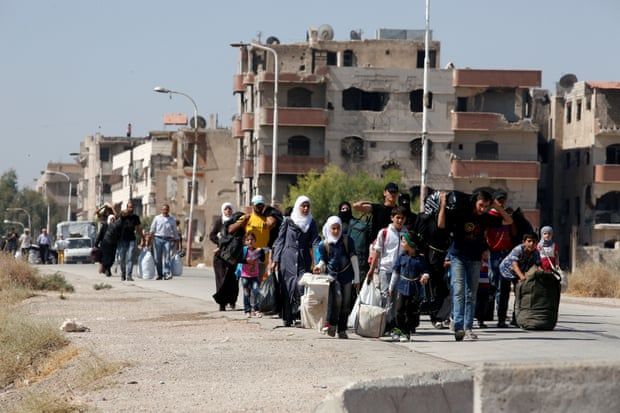
Daraya, pictured during an evacuation in 2016, has seen many property seizures by the state.


ADMSP describes how the dictatorial regime of Bashar al-Assad honed legal methods to confiscate property from detainees as part of a brutal crackdown on protests following the Syrian uprising of 2011.

Those accused of joining demonstrations or carrying out anti-government activity were convicted under an anti-terrorism law that permits the state to permanently strip them of all civil rights and opt to seize any property or belongings.

“It’s akin to a revenge or scare tactic that the regime is using,” said Diab Serrih of ADMSP, who pointed out that the seizures have reshaped Syria, as most of the property claimed by the state is in areas previously associated with dissent, such as Daraya in the south, and Homs and Aleppo in the north.

Tarek Ibrahim, whose name has been changed for his safety, described how the government seized 15,000 sq metres of his family’s land near Damascus. “I had many beautiful memories of that place,” he said. The state also seized properties and a computer equipment shop previously operated by his family.

Ibrahim was arrested along with two of his brothers in 2012 for being anti-government media workers in Aleppo. His family later learned that both his brothers were executed in Sednaya military prison, outside Damascus.

It was only after Ibrahim’s release from prison in 2020 that he learned he had been stripped of all civil rights, including the right to own property or possessions. The rulings against all three brothers meant the entire family’s property had been confiscated, including their parents’ land.

“All of our family properties are now held by the state. We can’t do anything with them – if we try to sell them or rent them, the government will seize them and arrest anyone involved,” he said.

Ibrahim said he decided to leave Syria after being detained and then ejected from a government building for attempting to obtain a passport for his young daughter. State bureaucrats saw that his paperwork bore a stamp showing he had been stripped of all civil rights. They warned him: “If you come back, we will have you arrested.”

Newsletter

Related Articles

Arab Press
0:00
0:00
Close
Saudi Arabia’s Careful Balancing Act in Relations with Israel Amid Regional and Domestic Pressures
Greenland, Gaza, and Global Leverage: Today’s 10 Power Stories Shaping Markets and Security
America’s Venezuela Oil Grip Meets China’s Demand: Market Power, Legal Shockwaves, and the New Rules of Energy Leverage
Trump’s Board of Peace: Breakthrough Diplomacy or a Hostile Takeover of Global Order?
Prince William to Make Official Visit to Saudi Arabia in February
Saudi Arabia Advances Ambitious Artificial River Mega-Project to Transform Water Security
Saudi Crown Prince and Syrian President Discuss Stabilisation, Reconstruction and Regional Ties in Riyadh Talks
Mohammed bin Salman Confronts the ‘Iranian Moment’ as Saudi Leadership Faces Regional Test
Cybercrime, Inc.: When Crime Becomes an Economy. How the World Accidentally Built a Twenty-Trillion-Dollar Criminal Economy
Strategic Restraint, Credible Force, and the Discipline of Power
Donald Trump Organization Unveils Championship Golf Course and Luxury Resort Project in Saudi Arabia
Inside Diriyah: Saudi Arabia’s $63.2 Billion Vision to Transform Its Historic Heart into a Global Tourism Powerhouse
Trump Designates Saudi Arabia a Major Non-NATO Ally, Elevating US–Riyadh Defense Partnership
Trump Organization Deepens Saudi Property Focus with $10 Billion Luxury Developments
There is no sovereign immunity for poisoning millions with drugs.
Mohammed bin Salman’s Global Standing: Strategic Partner in Transition Amid Debate Over His Role
Saudi Arabia Opens Property Market to Foreign Buyers in Landmark Reform
The U.S. State Department’s account in Persian: “President Trump is a man of action. If you didn’t know it until now, now you do—do not play games with President Trump.”
CNN’s Ranking of Israel’s Women’s Rights Sparks Debate After Misleading Global Index Comparison
Saudi Arabia’s Shifting Regional Alignment Raises Strategic Concerns in Jerusalem
OPEC+ Holds Oil Output Steady Amid Member Tensions and Market Oversupply
Iranian Protests Intensify as Another Revolutionary Guard Member Is Killed and Khamenei Blames the West
President Trump Says United States Will Administer Venezuela Until a Secure Leadership Transition
Delta Force Identified as Unit Behind U.S. Operation That Captured Venezuela’s President
Saudi-UAE Rift Adds Complexity to Middle East Diplomacy as Trump Signals Firm Leadership
OPEC+ to Keep Oil Output Policy Unchanged Despite Saudi-UAE Tensions Over Yemen
Saudi Arabia and UAE at Odds in Yemen Conflict as Southern Offensive Deepens Gulf Rift
Abu Dhabi ‘Capital of Capital’: How Abu Dhabi Rose as a Sovereign Wealth Power
Diamonds Are Powering a New Quantum Revolution
Trump Threatens Strikes Against Iran if Nuclear Programme Is Restarted
Why Saudi Arabia May Recalibrate Its US Spending Commitments Amid Rising China–America Rivalry
Riyadh Air’s First Boeing 787-9 Dreamliner Completes Initial Test Flight, Advancing Saudi Carrier’s Launch
Saudi Arabia’s 2025: A Pivotal Year of Global Engagement and Domestic Transformation
Saudi Arabia to Introduce Sugar-Content Based Tax on Sweetened Drinks from January 2026
Saudi Hotels Prepare for New Hospitality Roles as Alcohol Curbs Ease
Global Airports Forum Highlights Saudi Arabia’s Emergence as a Leading Aviation Powerhouse
Saudi Arabia Weighs Strategic Choice on Iran Amid Regional Turbulence
Saudi Arabia Condemns Sydney Bondi Beach Shooting and Expresses Solidarity with Australia
Washington Watches Beijing–Riyadh Rapprochement as Strategic Balance Shifts
Saudi Arabia’s Vision 2030 Drives Measurable Lift in Global Reputation and Influence
Alcohol Policies Vary Widely Across Muslim-Majority Countries, With Many Permitting Consumption Under Specific Rules
Saudi Arabia Clarifies No Formal Ban on Photography at Holy Mosques for Hajj 2026
Libya and Saudi Arabia Sign Strategic MoU to Boost Telecommunications Cooperation
Elon Musk’s xAI Announces Landmark 500-Megawatt AI Data Center in Saudi Arabia
Israel Moves to Safeguard Regional Stability as F-35 Sales Debate Intensifies
Cardi B to Make Historic Saudi Arabia Debut at Soundstorm 2025 Festival
U.S. Democratic Lawmakers Raise National Security and Influence Concerns Over Paramount’s Hostile Bid for Warner Bros. Discovery
×