

Syrians struggle to survive in ‘no man’s land’ desert camp
The Syrian government and its Russian backers have tightened their blockade on Rukban camp, a makeshift settlement housing about 10,000 internally displaced Syrians in the arid “no man’s land” between the Jordanian, Iraqi, and Syrian borders.
Nearly 80 percent of the camp’s residents are women and children, living in squalid conditions. For more than three years the al-Assad regime has blocked United Nations aid from entering the camp, forcing its residents to survive off menial amounts of smuggled-in goods.
“The lack of food is killing us,” said Ahmad, a resident of the camp who has been stuck there for seven years, using a pseudonym for security reasons.
Ahmad told Al Jazeera that his wife had recently miscarried her baby five months into pregnancy and that his elderly parents were in poor health conditions.
“There’s literally nothing in the camp. There are no professional doctors. People die and we do not know the cause of death,” Ahmad said.
The camp sits within a 55km (34 miles) “deconfliction zone” that surrounds the United States’ al-Tanf base, where the US trains its partner forces against ISIL (ISIS) and disrupts the activities of Iranian proxy forces
US forces are able to patrol the deconfliction zone, alongside Syrian opposition forces, after a deal with Russia in 2016.
However, outside the zone’s perimeters, the camp residents are forced to return to regime-controlled territory, said Mouaz Moustafa, the executive director of the Syrian Emergency Task Force (SETF) which is in direct contact with those in Rukban.
A 2021 Amnesty International report documented the torture, enforced disappearance, and sexual violence dozens of Syrian refugees faced upon their return to regime-held areas.
According to the report, at least 10 individuals who returned from Rukban were detained, three of whom faced torture or ill-treatment, and two were forcibly disappeared. Another 174 returnees were arrested and sent to “terrorism” courts, despite Russian and Syrian government safety guarantees.
“We would rather die here than go back to the Syrian regime,” said Ahmad.
Unbearable conditions in the camp have now forced out most of its 2019 population of 30,000. But “no matter how desperate they are”, those that remain in the camp are highly unlikely to leave, said Moustafa, and the only option left for these victims of the geopolitical impasse is to plead for help.
“My mother is suffering in front of me and I can’t do anything about it, and my father is about to lose his sight,” Ahmad said. “I cry like a small baby seeking help.”
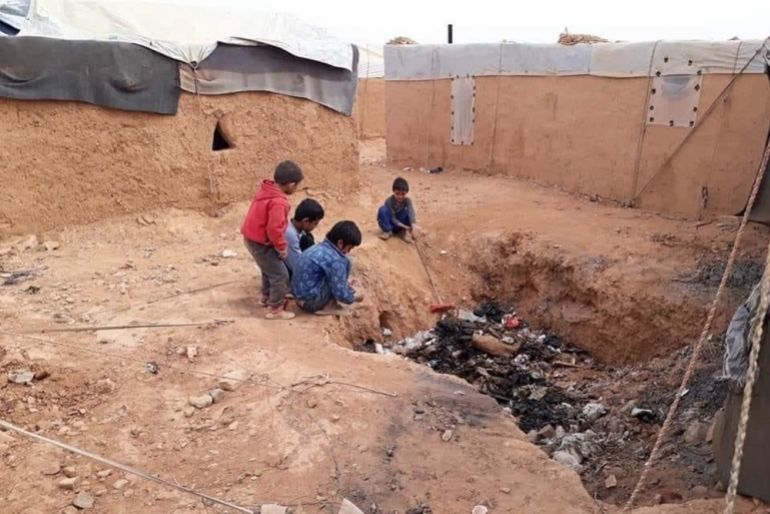 Children sort through a rubbish pit in Rukban
Failed humanitarian approach
The US continues to rely on the United Nations office in Damascus to support Rukban despite its own presence at al-Tanf base.
“We reiterate that the Assad regime and Russia should provide unhindered humanitarian access to the camp, and that humanitarian supplies should accompany any access to the camp,” a US State Department spokesperson said.
Jordan has prevented humanitarian aid from crossing its border with Syria since 2016 after six soldiers were killed in an ISIL suicide bombing.
In line with a number of other Arab countries, Jordan now seems to be warming its relations with President Bashar al-Assad.
An official spokesperson for the Jordanian government told Al Jazeera, “Rukban camp is located within the Syrian territories. Therefore, responsibility for the camp falls on the United Nations and the Syrian government.”
For its part, the Iraqi government keeps the main road towards Rukban closed, making it impossible for aid to come from Iraq.
Early last month, a bipartisan group of US lawmakers urged the Biden administration to address the crisis in Rukban, but no actionable response has yet materialised.
“The US needs to admit that this process has obviously failed and look at other ways to get aid into the camp,” Moustafa stated.
Health situation deteriorates
In 2019, Jordan shut the doors of an NGO-run clinic allowed to operate near its border with Syria, cutting off the only remaining lifeline for those in the camp with emergency health cases.
“We need everything, but most importantly, we need medical aid and healthcare,” Abu Mohammad, a civilian leader in the camp, told Al Jazeera. “Many people die from treatable illnesses.”
“My father died in Rukban, he had a stroke,” Mohammad said, “He needed medical attention. But there were no doctors or anything.”
Children in the camp, who make up half of the population, are at extreme risk of severe illness and malnutrition, according to Moustafa. In just the first two months of 2019, one child died every five days due to the lack of healthcare, a SEFT report noted.
Babies continue to be born at the camp, but the health centre lacks proper incubators and oxygen cylinders to care for the newborns, which has resulted in the death of some infants, according to a Syria Justice and Accountability Center report.
The report also states that multiple pregnant women who required a caesarean section were forced to the regime-held areas, where they were placed in detention centres and made to pledge to not return to their families.
“We either have to go to the Assad regime or die in the camp,” Mohammad stated.
Boiling point
As the siege worsens, people have “become more and more desperate”, said Moustafa. “It’s coming to a boiling point.”
“We’ve lost all hope,” said Mohammad, “There is no education … No one is looking towards us. No one is answering our pleas. No one has cared.”
Over the past few weeks, camp residents have participated in sit-ins near the US base; a demonstration of their mounting frustrations, noted Moustafa. He said the residents have proposed two solutions: either to get sustained aid into the camp or to facilitate safe passage to an area in Syria outside of the government’s control.
“Never in a million years did we think we would be in the position we are in now,” Mohammad said. “We, the Syrian people, we’re not used to not having education, we’re not used to being in the place we’re in now. We’re not used to asking for help.”