

Through war and decay, Libya’s ‘desert pearl’ tries to hold on
In the heart of the Libyan Sahara is a city known as the ‘pearl of the desert’ – built up around an oasis that has been a refuge for thousands of years.
Six hundred kilometres southwest of the capital Tripoli, caravans would pass by the area, and once the water spring was found, people settled and the area flourished, becoming an economic hub for caravan trade connecting all of Africa as part of the trans-Saharan network.
On a recent reporting trip, we entered through one of the mud arches leading into the old city, and were greeted by birds singing, as if to say, “We’ve been waiting for you.”
But, much like the rest of Libya, not everything is going so well for this city.
The Ghadames old city is a UNESCO world heritage site, but is now on the endangered list.
We meet Abdullah Musa, a local journalist who heard we were in town. He explains that the decision was more than just a PR problem.
“The people of Ghadames were surprised and have suffered greatly due to the UNESCO decision to put the old city on its endangered list,” Musa says.
The issue is that Ghadames relies heavily on tourism to support its local economy. Numerous meetings between local officials and UNESCO over the years have been held, but it is not clear if the decision will soon be reversed.
“European tourists would feel safer to travel to Ghadames if it were off the list,” Musa says.
There used to be many here in this corner of the desert.
Khalid Alhaji, our tour guide, owns a coffee shop in the old city.
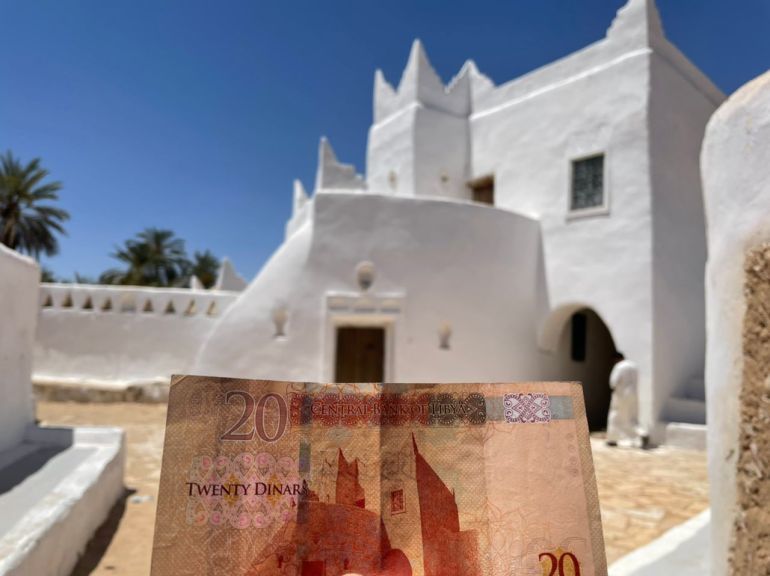 One of the oldest girls’ schools in North Africa is in Ghadames
It is adorned with colourful traditional trinkets and antique tea kettles.
While preparing our tea on a bed of coals, he beams with delight when he reminisces and tells us of a time when business was good.
“They came from Italy, France, Germany, all over Europe and even from America. The Americans are great tourists. They spend a lot,” he says as he rubs his thumb and index finger symbolising money. But his smile disappears and he sighs, “now my coffee shop is empty”.
Thousands of foreign tourists used to come and visit, but for more than a decade, instability and war in Libya has kept them away.
A once thriving city, its narrow alleyways are now for the most part deserted.
While walking through, you can feel the history. The old cracked walls hide stories of a once-flourishing people between them.
We arrive at the oasis, the city’s crown jewel. Alhaji says that the spring is at least 4,000 years old.
Ghasouf, as it is known, has been breathing life into the ancient city for centuries. Five water tunnels fed by the Ghasouf stretch throughout the entire old city, supplying homes, mosques and farms.
Everything in Ghadames is designed to alleviate the difficulties of living in the desert, whether it is the management of water, or the long, dark alleyways that help to keep residents cool.
The city has remained through Roman, Byzantine and Islamic empires. It has survived, while all those empires have disappeared. But it needs more attention and funding to get it through Libya’s current strife, and at the moment, that is not forthcoming.
Forgotten city?
As we continue our tour of the old city, we come across an old school. It is painted white and glistens in the sun.
In front of it, we are met by Ibrahim Malik. He works for the Ghadames Urban Development Authority, responsible for maintaining and preserving the old city.
He takes out a 20-dinar Libyan note, and says “do you notice this place?”
A picture of the school is embossed on the back of the bill.
“This girl school is one of the oldest in North Africa, and we recently renovated it” Malik tells me. “But we have a lot of work to do, Ghadames is one of the oldest cities in the world, preserving the city is important for all mankind. Not just Libya”.
Malik explains to me that all of Libya’s historical sites suffer due to a lack of attention, but Ghadames being in the middle of the desert deserves special care.
“Officials in Libya have never prioritised tourism and we suffer from a lack of funding. Every year we submit our budget proposal, but we only receive about one percent of what we request. We do what we can with the little we get.”
As we delve deeper into the city with Alhaji, we come across a home that has fallen over as a result of rainfall. The rubble is all that remains.
My face gives my sadness away, but I’m quickly told there is far worse.
We walk through long and snaky alleyways across the old city. At times, it is so dark we have to turn our flashlights on our phones to see where we’re walking.
Out of a doorway into the sunlight, we’ve arrived in an open space across from the Ghasouf.
We see a group of homes that has been completely flattened. “These homes were hit by an air strike in 1943 [during World War II] – not a single government since that time has thought about renovating these homes.”
It is a bitter reminder that not everything can be rebuilt after war, a sombre message to think about when considering Libya’s coastal cities that have been fought over, and are still fought over, in recent years.
Our tour guide, Alhaji, speaks for many Libyans when he says he just hopes for stability.
“I’m optimistic for the future,” he says. “But I hope that, after all these years, people haven’t forgotten us.”