

US Facing Pressure to Deny Iran's President Visa for UN Visit
The State Department on Thursday indicated it would not deny a visa for the Iranians planning to attend the 77th session of the U.N. General Assembly in mid-September.
"Visa records are confidential under U.S. law; therefore, I can't discuss the details of individual visa cases. But I would reiterate what we've said before: that as a host nation of the U.N., the U.S. is generally obligated under the U.N. Headquarters Agreement to issue visas to representatives of U.N. member states to travel to the U.N. headquarters district," State Department deputy spokesperson Vedant Patel said in response to a question from VOA News.
"The U.S. takes seriously its obligations as a host country of the U.N., but again, visa records are confidential, and therefore I can't get into anything else," Patel added.
Guaranteed rights
Under the 1947 agreement regarding the U.N. headquarters in New York, the host nation guarantees rights of entry, movement and residence to those invited to U.N. meetings.
"We've been in a similar place before, facing up to the prospect of our enemies using our trucial obligations hosting the U.N. to exploit the UNGA stage — think Fidel Castro or Yasser Arafat," said Danielle Pletka, distinguished senior fellow in foreign and defense policy studies at the American Enterprise Institute. "In general, the United States has bent to the legal opinion of the U.N. affirmed by the General Assembly that we do not have that right. Still, we have on occasion refused to grant visas."
The United States, which has no diplomatic relations with Iran, should deny visas for Raisi and the other government officials traveling from Tehran because "other than al-Qaida, the Iranians have been responsible for the most American deaths in the last 50 years," Pletka told VOA. "There must be a price to be paid for trying to kill Americans on American soil. If we ignore this, what won't we ignore?"
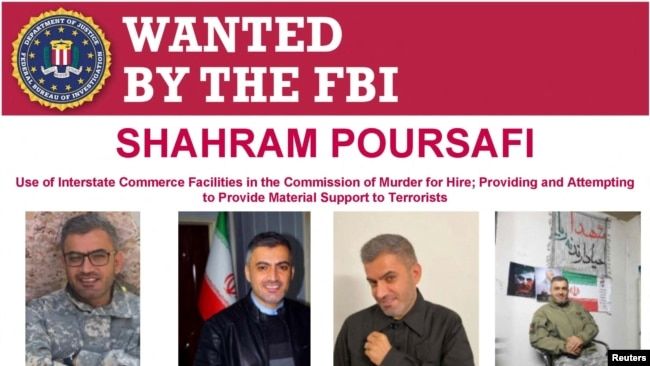
Earlier this month, the U.S. Justice Department said an Iranian operative was charged in a plot to assassinate former U.S. national security adviser John Bolton in presumed retaliation for a U.S. airstrike that killed a powerful Iranian general.
The suspect, Shahram Poursafi, was identified by U.S. officials as a member of Iran's Islamic Revolutionary Guard Corps. He is currently wanted by the FBI on charges related to the murder-for-hire plot.
Iran called the charges politically motivated.
The plot to murder Bolton was "done under the watch of Raisi," wrote Alireza Jafarzadeh, deputy director of the Washington office of the National Council of Resistance of Iran, in an editorial for The Patriot-News of Harrisburg, Pennsylvania. "With this track record, Raisi is now seeking rewards from the 'Great Satan' to grant him a visa to enter the United States, where he was plotting to kill senior American officials, and attend the United Nations General Assembly in September."
'Butcher of Tehran'
Raisi is also alleged to be responsible for the deaths of hundreds of thousands of Iranians. Amnesty International has called for the U.N. Human Rights Council to investigate the Iranian president for "crimes against humanity."
Raisi is known as the "butcher of Tehran" among activists for his activities as a prosecutor and a member of a so-called "death committee." He has been subject to U.S. sanctions since 2019 for "complicity in serious human rights violations."
Last September, two months after taking office, Raisi, a cleric, delivered a prerecorded address to the United Nations. There are indications he intends to speak in person this year at the United Nations. His visit there would likely prompt demonstrations in midtown Manhattan, and the federal government would be obligated to spend taxpayers' money to protect the controversial foreign head of government.
"Dozens of U.S. Secret Service agents will be ready to take a bullet for a man whose government has authorized and funded operations against innocent U.S. citizens on American soil," Yashar Ali, a high-profile Iranian American freelance journalist, wrote in his newsletter.
"In order to
maintain operational security, the Secret Service does not discuss protective operations," Special Agent Steve Kopek told VOA in response to a query about whether the agency would protect the Iranian president.
"Banning Raisi and his delegation from entering the United States may cause more criminal behavior and hostile and provocative actions, but nothing must come before protecting US citizens on US soil," said Ali in his newsletter.
In a column in the Scotsman newspaper, Struan Stevenson, the coordinator of the Campaign for Iran Change and president of the European Iraqi Freedom Association, expressed hope U.S. President Joe Biden would "rediscover his backbone" and agree that Raisi should not be granted a visa.
"It seems unlikely that the Biden team will deny a visa to Raisi or his delegation," said Pletka of the American Enterprise Institute. "Were there to be clear evidence that someone on that delegation were directly implicated in the threats against former U.S. officials, there would be a good case to be made."