Gaza Reconstruction Funding Gap Must Be Closed Urgently, Trump’s Board of Peace Reports
The US president's Gaza rebuilding plan faces a potential cash crunch as the gap between funding pledges and disbursement widens.
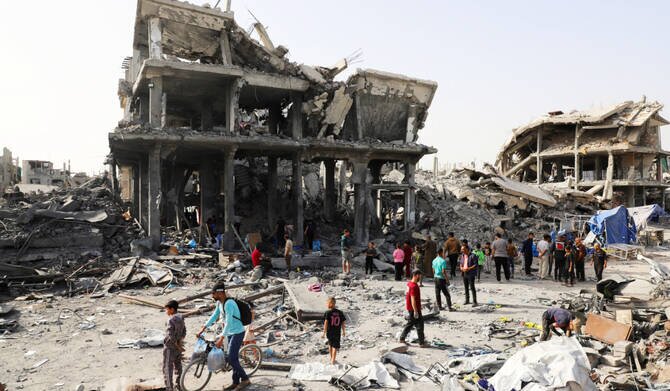
GENEVA: The reconstruction of Gaza is facing a significant financial hurdle according to a recent report by the US President's 'Board of Peace', established to oversee his ambitious plan aimed at ending Israel's war in Gaza and rebuilding the territory.
Estimated to cost $70 billion, funding pledges have yet to translate into substantial disbursements, prompting concerns about a potential shortfall.
The Board of Peace was set up by Donald Trump to tackle conflicts including the Israeli-Palestinian issue.
While recognized by the UN Security Council, its membership is not universal, with key players and smaller states participating unevenly.
As of now, the board has only secured a fraction of the $17 billion pledged towards Gaza's rebuilding, according to recent reports.
In response to these concerns, the Board of Peace issued a statement clarifying its role as an 'execution-focused organization' tasked with securing funds as needed and denying any funding constraints.
The money is intended not only for reconstruction efforts but also to support a new US-backed transitional government in Gaza.
The May 15 report to the UN Security Council emphasizes the urgency of closing the gap between committed funding and actual disbursements, highlighting that without swift action, the plan risks failing to deliver tangible benefits to the people of Gaza.
The board has urged countries yet to contribute to expedite their processes and called on non-member states to join in the reconstruction efforts without delay.
Contributions have been pledged by the US, Saudi Arabia, the UAE, Qatar, Morocco, Uzbekistan, and Kuwait, among others.
Despite these commitments, the report underscores a need for increased transparency and oversight concerns that have led some countries to prefer financing Gaza's reconstruction through traditional institutions like the UN, European, and Asian officials note.
Under the Board of Peace’s charter, member states would be limited to three-year terms unless they pay $1 billion each for permanent membership.
The feasibility and implementation details of this requirement remain unclear.
Efforts to secure funding have included considering redirection of withheld Palestinian Authority funds from Israel, though no definitive actions have been publicly announced.
The situation highlights the complexity and challenges involved in financing the reconstruction of Gaza, a key component of Trump’s broader Middle East peace plan.
The gap between pledged support and actual disbursement underscores the need for urgent action to ensure that rebuilding efforts can proceed effectively.
Estimated to cost $70 billion, funding pledges have yet to translate into substantial disbursements, prompting concerns about a potential shortfall.
The Board of Peace was set up by Donald Trump to tackle conflicts including the Israeli-Palestinian issue.
While recognized by the UN Security Council, its membership is not universal, with key players and smaller states participating unevenly.
As of now, the board has only secured a fraction of the $17 billion pledged towards Gaza's rebuilding, according to recent reports.
In response to these concerns, the Board of Peace issued a statement clarifying its role as an 'execution-focused organization' tasked with securing funds as needed and denying any funding constraints.
The money is intended not only for reconstruction efforts but also to support a new US-backed transitional government in Gaza.
The May 15 report to the UN Security Council emphasizes the urgency of closing the gap between committed funding and actual disbursements, highlighting that without swift action, the plan risks failing to deliver tangible benefits to the people of Gaza.
The board has urged countries yet to contribute to expedite their processes and called on non-member states to join in the reconstruction efforts without delay.
Contributions have been pledged by the US, Saudi Arabia, the UAE, Qatar, Morocco, Uzbekistan, and Kuwait, among others.
Despite these commitments, the report underscores a need for increased transparency and oversight concerns that have led some countries to prefer financing Gaza's reconstruction through traditional institutions like the UN, European, and Asian officials note.
Under the Board of Peace’s charter, member states would be limited to three-year terms unless they pay $1 billion each for permanent membership.
The feasibility and implementation details of this requirement remain unclear.
Efforts to secure funding have included considering redirection of withheld Palestinian Authority funds from Israel, though no definitive actions have been publicly announced.
The situation highlights the complexity and challenges involved in financing the reconstruction of Gaza, a key component of Trump’s broader Middle East peace plan.
The gap between pledged support and actual disbursement underscores the need for urgent action to ensure that rebuilding efforts can proceed effectively.