Arab Press

بالشعب و للشعب
Thursday, Jul 16, 2026

Carnival Cruise boss banks on safety measures

Carnival Cruise boss banks on safety measures

The boss of the world's biggest cruise company has told the BBC new safety measures can help the $150bn (£113bn) a year industry to get going again.

The hugely profitable business has been brought to its knees by coronavirus after regulators around the world stopped ships from sailing to try and limit outbreaks.

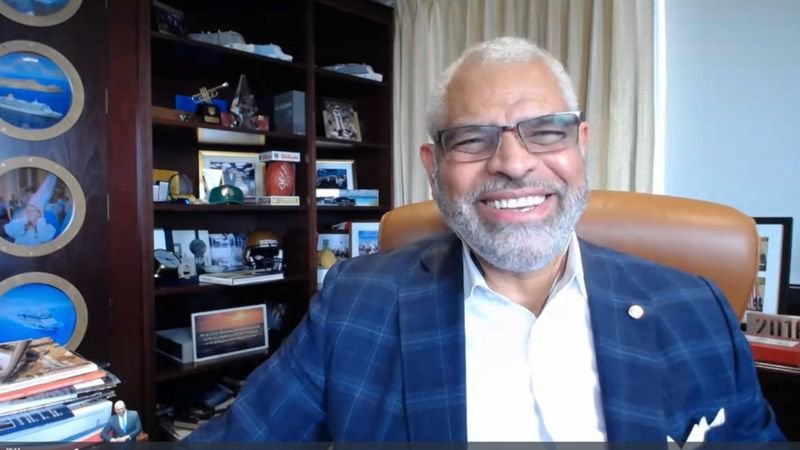
Arnold Donald, the chief executive of Carnival Corporation, said "universal testing, which doesn't exist in any other industry of scale" will help mitigate the risk of an outbreak.

He added that "additional medical screenings, physical distancing, mask wearing" could be among further measures.

However, there have been outbreaks of coronavirus on some of the few cruises that have set sail recently, including the Carnival-owned Costa Diadema which has been sailing in the Mediterranean Sea.

Mr Donald concedes that "you cannot guarantee that you're going to be Covid-free no matter what regimen you put in place".

Although, he insists, "it can be managed and managed effectively" and that collaborating with authorities around the world means that has been done "reasonably effectively" so far.
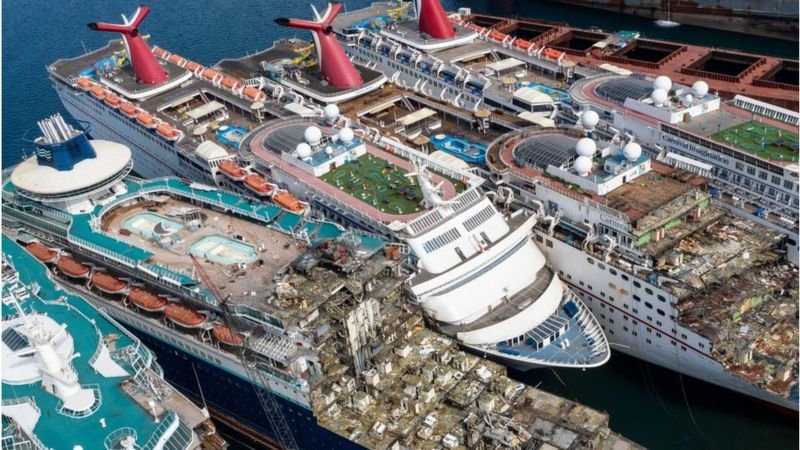

A number of cruise ships were scrapped this year


The company has drafted in a raft of health and scientific advisers to draw up its protocols.

Mr Donald says "our priority, of course, is to make cruising work in a way where we have every confidence there's no greater risk than if you were engaging in similar activity shore-side".

The difficulties of achieving that were laid out by the US Centre for Disease Control (CDC), which in lifting its ban on cruise ships, said that without mitigations "cruise ships would continue to pose a greater risk of Covid-19 transmission than other settings".

Two outbreaks on cruise ships early in the pandemic have been detrimental to the cruise industry, with passengers dying after outbreaks on both the Diamond Princess, which was quarantined by Japan, and the Grand Princess, which eventually docked in California.

'Cautiously optimistic'


Traditionally, cruising has a loyal customer base and that has given Mr Arnold grounds for optimism.

He says for the second half of next year "bookings have been robust. People really want to cruise when it's safe to do so". He adds "we're cautiously optimistic we'll be sailing in early 2021", albeit a few ships at a time.

The financial imperative to get going again is clear.

Despite scrapping 18 of its 105 ships, Carnival is losing about $650m a month. After raising more than $12bn from investors, Mr Arnold says, "even if we had zero revenue, we could go through in to the summer of next year".


Other than that the money has pretty much stopped coming in.

The summer is normally the busiest time of the year but from July to August Carnival brought in just $31m. None of that was from ticket sales, and it compares to $6.5bn in the same time last year, 68% of which was from tickets.

The lack of paying passengers reflects the huge uncertainty hanging over an industry that thrives on thousands of passengers at a time, travelling in relatively close confines, two things that have been severely restricted to try and control coronavirus.

According to Monique Giese, who tracks the shipping industry for the consultancy KPMG, the cruise industry is very much at the mercy of the virus.

Back to work?


She says "it is very difficult to give any forecast for the next year. The cruise industry is going to lose the very profitable winter season specifically in the Caribbean area."

Test runs are amongst the strict conditions that have been laid out by the CDC before cruises can resume in the US.

It's the most important market for the industry, accounting for nearly 50% of the 30m passengers who take a cruise each year.

The industry has voluntarily stopped sailings in the US until the end of year. However Congress is investigating whether or not the Trump White House interfered to stop the CDC extending the mandatory ban into next year.

President-elect Joe Biden has taken a markedly different approach to tackling coronavirus but Mr Donald says "we don't have any concerns" that a new administration will lead to a new no-sail order and more financial problems.

Before the pandemic, the Cruise Line Industry Association calculated that its members supported 1.2m jobs worldwide, and when the US no-sail order was lifted its President Kelly Craighead said she was "confident that a resumption of cruising in the US is possible to support the economic recovery" whilst protecting public health.

However, ships are being scrapped by several lines, meaning that jobs will be lost. For those that remain, Mr Arnold says "it's important to get people back to work".

You can watch Arnold Donald's full interview on Talking Business with Aaron Heslehurst this weekend on BBC World News at Saturday 2330 GMT, Sunday 1630 GMT, Monday 0730 GMT and 1130 GMT and Tuesday at 1330 GMT.

Comments

Oh ya 6 year ago
If the trip was 100% free I would still never get on the petri dish and that was before the virus. Had a friend who worked the ships you should hear what they call and think of you the paying customer. For example.... It's time to break out the slop pails and feed the pigs.

Newsletter

Related Articles

Arab Press
0:00
0:00
Close
Spain in Ecstasy: "We Feel Unbeatable, We Taught the Whole World a Lesson"
Harvard Astrophysicist to Lead U.S. Scientific Advisory on Unidentified Aerial Phenomena
Emergency Sirens Activated Across Bahrain as Interior Ministry Issues Shelter Directives
World Cup Visitors Turn American Big-Box Stores Into Souvenir Stops
Netflix Weighs Always-On Channels, Bundles and Short-Form Video
The AI Invoice Shock: Layoffs Didn't Save Managers Money — They Cost Them More
Concern: Sexually Transmitted Bacterium Among Men Develops Antibiotic Resistance
Passenger Partially Pulled Out of Ryanair Jet After Cabin Window Fails Mid-Flight
Severe Heatwave Drives Dangerous Ground-Level Ozone Pollution Across Two Thirds of European Union
The Physical and Electronic Barriers Disrupting Domestic Wireless Networks
France and Morocco Open World Cup Quarter-Finals as Collina Defends Refereeing
Tech Pulse: The Future of AI and Screen Culture
Global News Briefing: Escalating Geopolitical Tensions and Corporate Shakeups
Global News Brief: Escalating Conflicts, Public Health Crises, and World Cup Drama
Europe's Growing Struggle with Extreme Heat and Air Conditioning
Anthropic Reengineers Agentic Architecture to Shift Autonomous Workplace Automation to the Cloud
Logic Flaw in Windows 11 Permission Architecture Silently Consumes Hundreds of Gigabytes of Local Storage
Apple Advances Late-Stage Operating Systems with Fourth Beta Deployments
Global Crisis Alert: Escalating Middle East Tensions and UK Political Upheaval
Japanese Technology Firm Fujitsu Launches Advanced Artificial Intelligence Tool for Corporate Disclosures
South Africa Officially Launches Nationwide Campaign for Highly Contested Local Government Elections
United Kingdom Commits Additional Funding for Unexploded Ordnance Clearance in Laos
Singapore Announces Stringent New Greenhouse Gas Regulations for Commercial Cooling Systems
Cambodia and Thailand Hold High-Level Border Security Talks at United Nations Headquarters
Myanmar Military Government and China Sign Major Agreement to Upgrade Media and Cultural Cooperation
Knife Attack at Swiss Train Station Leaves Three Injured in Suspected Act of Domestic Terrorism
Transnational Extortion Gang Threatens Canadian Police With Army of One Thousand Armed Operatives
Australia Imposes Forty-Two-Day Quarantine on Cruise Ship Passengers Following Deadly Hantavirus Outbreak
International Monetary Fund Unlocks Seven Hundred Million United States Dollars for Sri Lanka Following Economic Reforms
Australia Launches Record One Point Four Billion Dollar Lawsuit Against Chemical Giant 3M Over Contamination
China and Canada Foreign Ministers Meet in Ottawa in Effort to Stabilize Strained Diplomatic Ties
Indonesia Demands Urgent United Nations Security Council Reform Amid Escalating Global Conflicts
Extreme Weather Patterns Trigger Severe Drought in Madagascar and Destructive Flooding in East Africa
Indian State of Karnataka Faces Political Upheaval as Chief Minister Siddaramaiah Abruptly Resigns
Philippines and Japan Reaffirm Defense Ties as Crucial for Indo-Pacific Regional Stability
Norway Joins French Nuclear Deterrence Initiative in Major Shift for European Security Architecture
Global Critical Mineral Alliances Expand as Western Nations Move to Counter Chinese Supply Dominance
United States Imposes Fifty Percent Tariffs on Mexican Steel and Aluminum Ahead of Trade Pact Review
European Union and China Head Toward Major Trade Conflict Over Clean Technology Exports
United States Economic Growth Severely Downgraded to One Point Six Percent as Stagflation Fears Mount
World Health Organization Warns Central African Ebola Epidemic is Outpacing Containment Efforts
United States Treasury Department Conditions Sanctions Relief on Reopening of the Strait of Hormuz
Iranian Air Defenses Intercept and Destroy United States Military Drone Over Bushehr Province
Iranian Armed Forces Launch Ballistic Missiles Toward Unspecified Targets Prompting Regional Condemnation
United Nations Secretary-General Warns Global Order Facing Highest Level of Conflict Since 1945
Israel Issues Sweeping Evacuation Orders in Southern Lebanon Amid Intensified Hezbollah Conflict
Russia Announces Systemic Military Strikes Targeting Ukrainian Defense and Energy Infrastructure
United States and Iranian Negotiators Reach Draft Agreement to Extend Ceasefire and Resume Nuclear Talks
United Nations Security Council Deeply Divided Over United States Capture of Venezuelan President
US and Iran Exchange Direct Military Strikes Amid Fragile Gulf Ceasefire
×