

Covid-19 in old Hong Kong blocks, subdivided flats sparks strategy rethink
Hong Kong’s subdivided flats and improper sewage structures crammed into old buildings have exposed flaws in the city’s strategy against Covid-19
, health experts have warned, calling for a more proactive and timely approach.
The concern centred on fears over what was perceived by critics as a delayed response in tackling growing clusters in aged tenement blocks in Yau Tsim Mong district in the past week. This was despite government efforts to ramp up mandatory testing to cover bigger swathes of housing instead of individual blocks.
Late on Friday, the health department said it was taking the “exceptional” measure of issuing an isolation order for four residential blocks along Reclamation Street in Yau Tsim Mong district, where a cluster of infections is growing, in order to better carry out contact tracing. The step marked the first time authorities had effectively locked down entire buildings since the pandemic began last year.
The recent infections in tenement blocks at 20, 22, 24 and 26 Reclamation Street in Jordan also sparked an order for large-scale screening in the district.
“There are lots of old buildings in Hong Kong which could be potential outbreak sites. If a person there is a Covid-19 patient, the environment could easily amplify the problem and become a super-spreading site,” infectious disease specialist Dr Joseph Tsang Kay-yan said.
“Such living environments are crowded, there is a lack of maintenance, and the prevalence of subdivided units means illegal changes in flat structure and pipes are common.”
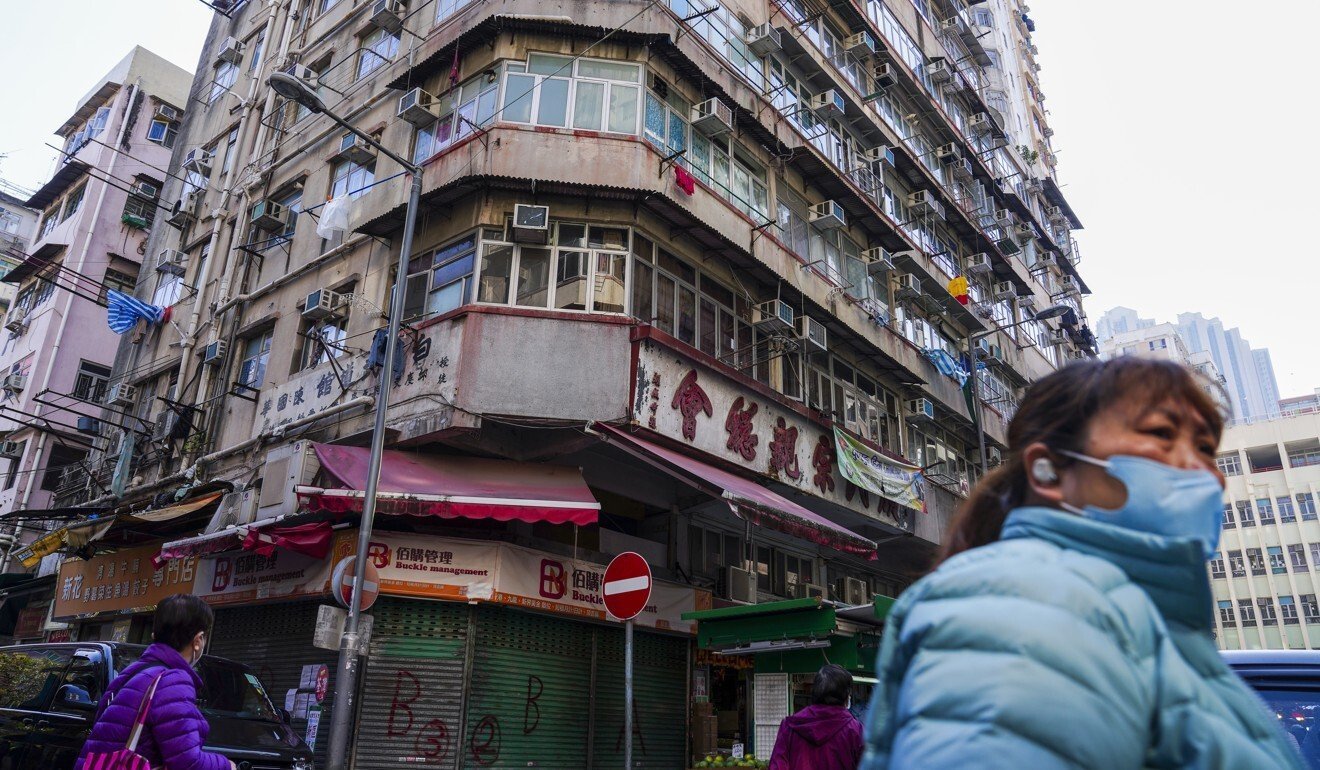
Built more than 50 years ago, the four buildings were filled with subdivided flats housing families mostly belonging to ethnic minority groups. A total of 33 infections have been reported from the site over the past two weeks.
A mandatory testing order was first issued for 26 Reclamation Street on January 8 after two coronavirus cases were recorded within that week. A new case was identified at No 20 two days later, followed by seven more at No 26 the next day. But the testing order was extended to cover all four interconnected blocks on January 12, only when the total number of infections had surged to 19.
More than 90 residents were evacuated two days later on Thursday after midnight, and experts were sent in to inspect sewage systems of the buildings to determine if they were transmission pathways.
Tsang said in the case of such buildings, mandatory testing should be triggered even if only one infection was detected, instead of the current citywide criteria of cases in two unrelated flats over a two-week period.
“If there is one infection in an old building, the [transmission] risk is already there,” he said, adding that there was a risk of infection as long as one person had the virus, given the problems with old plumbing.
He suggested authorities could also be more proactive in monitoring possible Covid-19 outbreaks by conducting regular sewage surveillance on old buildings.
“If we only take action when a confirmed case emerges from a building, there will be a time gap that can further amplify the problem,” he said.

Dr Leung Chi-chiu, a respiratory medicine specialist, said the infections at Reclamation Street had highlighted the problem of the government neglecting other risk factors in old tenement buildings.
“There are problems of subdivided units, pipes and clustering of ethnic minority groups,” which could lead to issues with communication, Leung said. “But there are no clear measures on how to follow up.”
According to a population by-census in 2016, Yau Tsim Mong had the biggest group of ethnic minority members among the 18 districts in the city, accounting for 9.1 per cent of the roughly 580,000 ethnic minority residents in the city.
Hong Kong Unison, an NGO focusing on the rights of ethnic minority groups, acknowledged that communications had been an issue since the Covid-19 outbreak began early last year.
The Home Affairs Department said it had passed health information to eight ethnic minority support centres, adding it had also hired workers who could speak the native languages of such groups, such as Urdu and Nepali, to visit buildings marked for mandatory testing.
But Unison said it could not identify any of those workers during an assessment done in late afternoon on Friday, noting they were told by authorities the foreign language specialists had been recruited by the department but were on standby.
The group complained there was “delay in sending ethnic minority workers to the affected buildings”.
Mandatory quarantine is currently required for close contacts of a confirmed patient. But questions have been raised over whether there could also be well-defined requirements for residents living in a block where infections have been found, after critics accused authorities of slow action regarding the Reclamation Street blocks.
Experts said such a decision would depend on individual situations.
“It must be decided on a case-by-case basis, and it must be determined if there are any environmental factors affecting particular units. There isn’t a simple formula to make this decision,” said Professor David Hui Shu-cheong, a government pandemic adviser.