Arab Press

بالشعب و للشعب
Thursday, Jul 16, 2026

Emergency vaccines ‘have proved effectiveness’, Chinese drug firm says

Emergency vaccines ‘have proved effectiveness’, Chinese drug firm says

An official from China National Biotec Group says the evidence from an emergency use scheme suggests the products are working.

Hundreds of thousands of Chinese have been given two experimental Covid-19 vaccines under an emergency scheme without a single case of infection, a top official with a state-owned vaccine developer has said.

Zhou Song, secretary for the commission for discipline inspection with China National Biotec Group, also said the company’s two candidate vaccines were likely to protect people for up to three years.

Zhou told China National Radio on Monday that the firm’s vaccines were the most widely used in the emergency scheme, adding: “Hundreds of thousands have taken the shot and no one has shown any obvious adverse effects or got infected.”

CNBG’s two vaccines are still undergoing phase three trials for safety and efficacy in several countries, including the United Arab Emirates, Bahrain, Peru, Morocco, Argentina and Jordan.

China’s emergency vaccine scheme began in late July and allows high-risk groups – including health care workers, diplomats and people who work abroad – to receive vaccines that have not yet been approved by regulators.


Zhou said that this group included tens of thousands of people who work overseas adding that the lack of infections “proves the effectiveness of the vaccines”.

Eight vaccines are currently undergoing phase three trials around the world, including four made by Chinese companies.

Three of the Chinese vaccines – including the two made by CNBG and one developed by Beijing based Sinovac-have been approved for emergency civilian use, while a fourth has been given the greenlight for use by the military.

Sinovac’s product is currently being tested in Brazil and Indonesia and the trial is expected to expand to more countries. The company has reportedly said that tens of thousands of people have already been given the vaccine under China’s emergency use scheme.

Meanwhile, the Chinese military has given the green light to the limited use of a candidate vaccine developed by CanSino and the Academy of Military Medical Sciences.

Yu Xuefeng, chairman of Tianjin-based CanSino Biologics, told state broadcaster China Central Television that those who needed the vaccine included troops “on peacekeeping missions in countries and regions where Covid-19 has yet to be put under control”. He did not say how many people had been given the vaccine.

CNBG’s vaccines have also been offered to employees of some businesses. Last week the pharmaceutical company announced that it had signed a deal with telecoms giant Huawei to offer vaccines and other treatments to employees.

The news website Caixin has also reported that an unnamed state-owned company in Beijing has also been offering its staff a vaccine since June, a month before the emergency use scheme started.
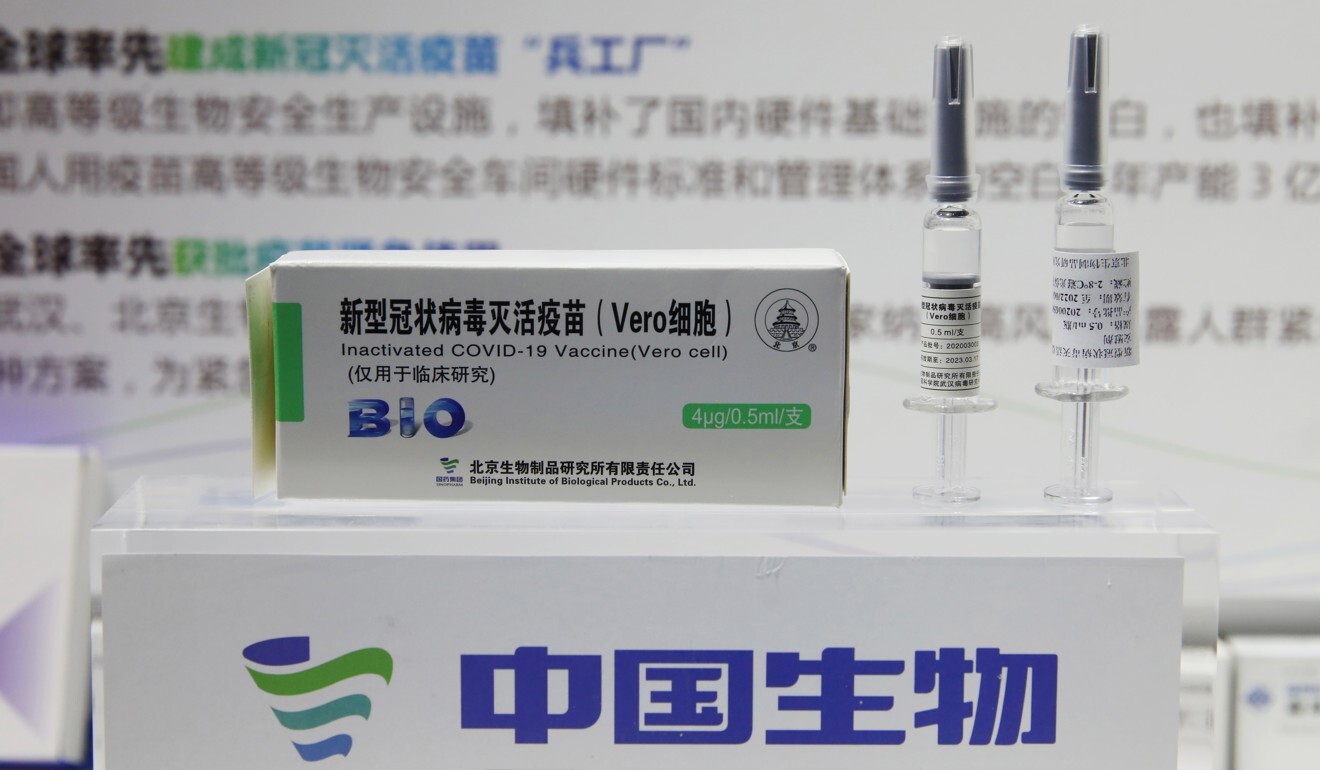

Two of CNBG’s vaccines have been approved for emergency use.


The report also said that the company – which operates in more than 30 countries – had asked all employees who have to travel overseas to take the injections and quoted one employee as saying that hundreds of people had agreed to do so.

Caixin also reported the Civil Aviation Administration of China has urged airline workers to take one of the candidate vaccines.

On Monday, Zhou dismissed suggestions that the vaccines might only offer protection for short periods.

The Covid-19 candidates were first tested on 180 senior executives and officials of CNBG’s parent company, the China National Pharmaceutical Group, also known as Sinopharm.

Zhou said they still showed high levels of antibodies, and added: “At present, based on the results of animal experiments, phased research results, and similar vaccines using similar technology, it is without question that immunity can last from one to three years.”

He also said it looks unnecessary to take annual shots like flu shots and the vaccine has covered the current known mutations of the coronavirus that causes Covid-19.

“There are indeed several subtypes of the virus that are mutating, but its main gene sequence and protein level has not fundamentally changed. The inactivated vaccine will have no problem in dealing with these mutated viruses in the next few years and can cover them,” Zhou said.

CNBG has built two secure facilities in Beijing and Wuhan to produce the vaccines. He said the annual production capacity of more than 220 million doses will rise to between 800 million to one billion when work to extend the facilities is complete.

Newsletter

Related Articles

Arab Press
0:00
0:00
Close
Spain in Ecstasy: "We Feel Unbeatable, We Taught the Whole World a Lesson"
Harvard Astrophysicist to Lead U.S. Scientific Advisory on Unidentified Aerial Phenomena
Emergency Sirens Activated Across Bahrain as Interior Ministry Issues Shelter Directives
World Cup Visitors Turn American Big-Box Stores Into Souvenir Stops
Netflix Weighs Always-On Channels, Bundles and Short-Form Video
The AI Invoice Shock: Layoffs Didn't Save Managers Money — They Cost Them More
Concern: Sexually Transmitted Bacterium Among Men Develops Antibiotic Resistance
Passenger Partially Pulled Out of Ryanair Jet After Cabin Window Fails Mid-Flight
Severe Heatwave Drives Dangerous Ground-Level Ozone Pollution Across Two Thirds of European Union
The Physical and Electronic Barriers Disrupting Domestic Wireless Networks
France and Morocco Open World Cup Quarter-Finals as Collina Defends Refereeing
Tech Pulse: The Future of AI and Screen Culture
Global News Briefing: Escalating Geopolitical Tensions and Corporate Shakeups
Global News Brief: Escalating Conflicts, Public Health Crises, and World Cup Drama
Europe's Growing Struggle with Extreme Heat and Air Conditioning
Anthropic Reengineers Agentic Architecture to Shift Autonomous Workplace Automation to the Cloud
Logic Flaw in Windows 11 Permission Architecture Silently Consumes Hundreds of Gigabytes of Local Storage
Apple Advances Late-Stage Operating Systems with Fourth Beta Deployments
Global Crisis Alert: Escalating Middle East Tensions and UK Political Upheaval
Japanese Technology Firm Fujitsu Launches Advanced Artificial Intelligence Tool for Corporate Disclosures
South Africa Officially Launches Nationwide Campaign for Highly Contested Local Government Elections
United Kingdom Commits Additional Funding for Unexploded Ordnance Clearance in Laos
Singapore Announces Stringent New Greenhouse Gas Regulations for Commercial Cooling Systems
Cambodia and Thailand Hold High-Level Border Security Talks at United Nations Headquarters
Myanmar Military Government and China Sign Major Agreement to Upgrade Media and Cultural Cooperation
Knife Attack at Swiss Train Station Leaves Three Injured in Suspected Act of Domestic Terrorism
Transnational Extortion Gang Threatens Canadian Police With Army of One Thousand Armed Operatives
Australia Imposes Forty-Two-Day Quarantine on Cruise Ship Passengers Following Deadly Hantavirus Outbreak
International Monetary Fund Unlocks Seven Hundred Million United States Dollars for Sri Lanka Following Economic Reforms
Australia Launches Record One Point Four Billion Dollar Lawsuit Against Chemical Giant 3M Over Contamination
China and Canada Foreign Ministers Meet in Ottawa in Effort to Stabilize Strained Diplomatic Ties
Indonesia Demands Urgent United Nations Security Council Reform Amid Escalating Global Conflicts
Extreme Weather Patterns Trigger Severe Drought in Madagascar and Destructive Flooding in East Africa
Indian State of Karnataka Faces Political Upheaval as Chief Minister Siddaramaiah Abruptly Resigns
Philippines and Japan Reaffirm Defense Ties as Crucial for Indo-Pacific Regional Stability
Norway Joins French Nuclear Deterrence Initiative in Major Shift for European Security Architecture
Global Critical Mineral Alliances Expand as Western Nations Move to Counter Chinese Supply Dominance
United States Imposes Fifty Percent Tariffs on Mexican Steel and Aluminum Ahead of Trade Pact Review
European Union and China Head Toward Major Trade Conflict Over Clean Technology Exports
United States Economic Growth Severely Downgraded to One Point Six Percent as Stagflation Fears Mount
World Health Organization Warns Central African Ebola Epidemic is Outpacing Containment Efforts
United States Treasury Department Conditions Sanctions Relief on Reopening of the Strait of Hormuz
Iranian Air Defenses Intercept and Destroy United States Military Drone Over Bushehr Province
Iranian Armed Forces Launch Ballistic Missiles Toward Unspecified Targets Prompting Regional Condemnation
United Nations Secretary-General Warns Global Order Facing Highest Level of Conflict Since 1945
Israel Issues Sweeping Evacuation Orders in Southern Lebanon Amid Intensified Hezbollah Conflict
Russia Announces Systemic Military Strikes Targeting Ukrainian Defense and Energy Infrastructure
United States and Iranian Negotiators Reach Draft Agreement to Extend Ceasefire and Resume Nuclear Talks
United Nations Security Council Deeply Divided Over United States Capture of Venezuelan President
US and Iran Exchange Direct Military Strikes Amid Fragile Gulf Ceasefire
×