

‘Hong Kong’s zero-Covid plan unsustainable’; 5 imported cases logged
Hong Kong’s coronavirus strategy of “zero infections” cannot be for the long term, a health expert has warned, urging more elderly people to get vaccinated to create better conditions for the easing of pandemic control measures.
Professor Ivan Hung Fan-ngai, co-convenor of the Expert Committee on Clinical Events Assessment Following Covid-19 Immunisation, said in a televised interview on Sunday that the city could further relax social-distancing rules once 80 to 90 per cent of the population had been inoculated.
Hung issued his ramped-up call for vaccination as the city confirmed five imported infections, bringing the overall tally to 12,057, with 212 related deaths.
“We can maintain the zero-infection streak, but Hong Kong cannot isolate itself forever as we are an international business hub. Our strategy needs to change over time,” Hung said. “But without achieving a very high vaccination rate of up to 90 per cent, we don’t have the conditions to open up.”
On Saturday, health minister Sophia Chan Siu-chee said the city had ditched travel talks with other places due to differences in strategies for containing Covid-19. She added that the government was still aiming to strike a balance between residents’ expectation of “zero infections”, while avoiding becoming “completely cut off” from the outside world.
The long-awaited travel bubble with Singapore was ditched on Thursday, after the city state moved towards a policy of “living with the virus”, in contrast to Hong Kong’s stricter approach.
The Commerce and Economic Development Bureau later said it would continue to communicate with places that had close economic ties to Hong Kong to facilitate travel during the pandemic.
Infectious disease expert Dr Leung Chi-chiu said that eventually relaxing Hong Kong’s strict pandemic control measures was a “no-brainer”, but argued the city needed to carefully consider when was the most prudent time to do so.
“Other countries have relaxed measures thinking they can ‘live with the virus’, but they still have vulnerable populations in their own countries,” he said. “They are just balancing their own political and economic needs, and Hong Kong can respect that, but it is not for us to do the same right now.”
Favourable conditions for relaxing the current restrictions would include ensuring more than 90 per cent of the elderly and chronically ill were vaccinated, Leung added.
“If we open up and there is a community spread, at least our medical system won’t be overwhelmed,” he said.
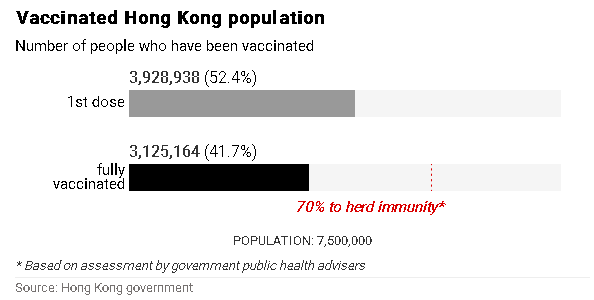
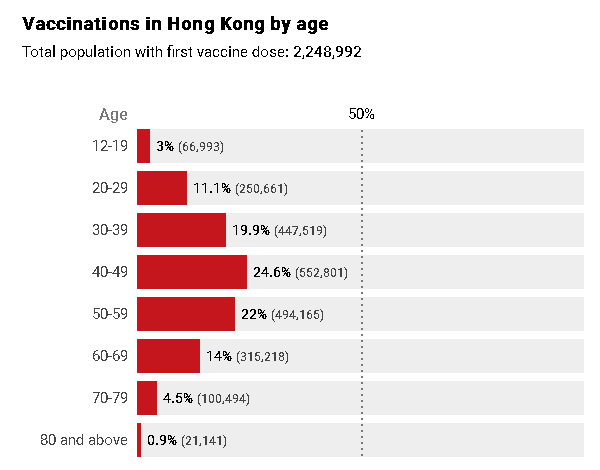
Health authorities are still engaged in a concerted effort to raise vaccination rates in the city, with only 41.3 per cent of 7.5 million residents fully vaccinated. Among the elderly, who are the most vulnerable, the rate of immunisation remains even lower, with only about 24 per cent of those aged 70 to 79 and 6.86 per cent of those aged 80 and above fully vaccinated.
Hung on Sunday reiterated the jabs were safe for elderly people, with under 2 per cent of those who had received vaccines suffering from serious side effects such as facial paralysis or strong allergic reactions. He added that his committee had ruled out links to vaccines in 22 out of 27 cases of deaths following a Covid-19 shot.
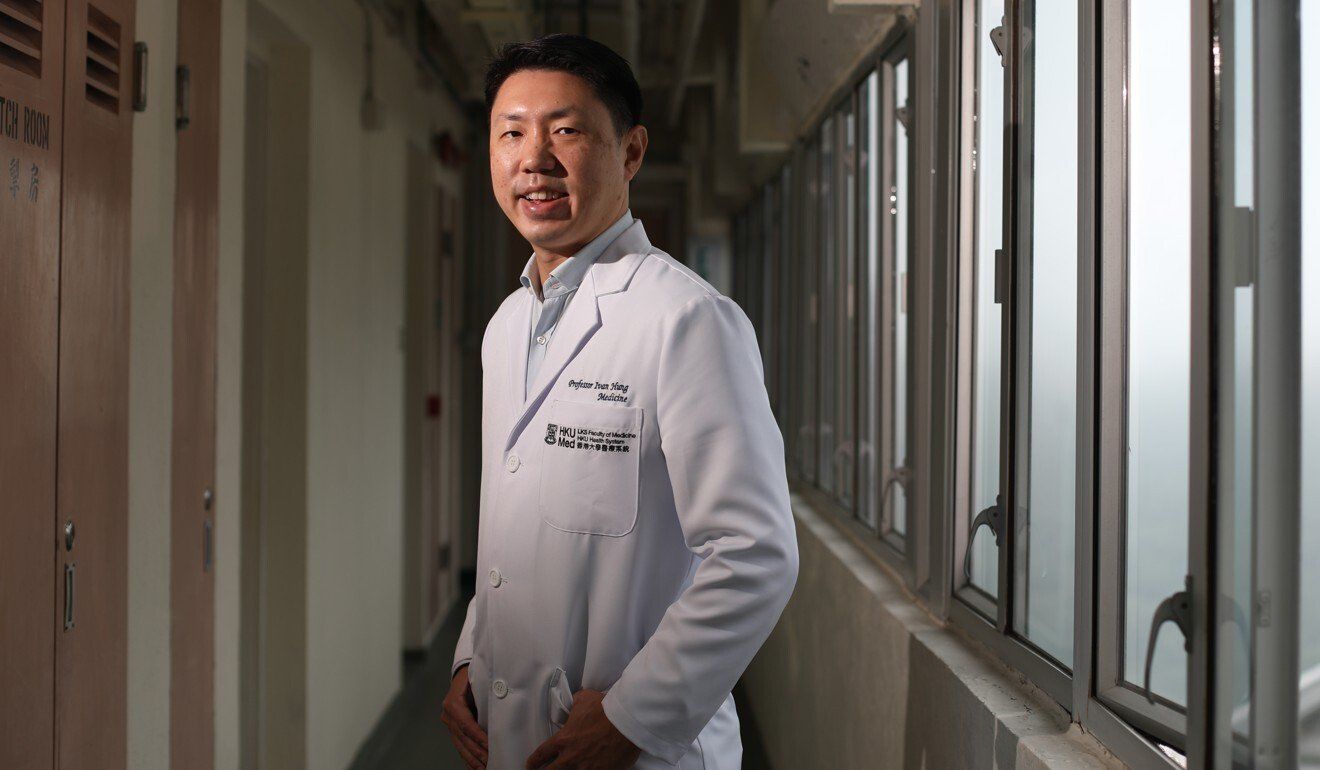 Professor Ivan Hung of the Expert Committee on Clinical Events Assessment Following Covid-19 Immunisation.
Hong Kong has largely kept coronavirus cases and deaths to a minimum, but has struggled to reopen its borders due to authorities’ insistence on a zero-infection strategy.
Under revised rules that took effect on Friday, 15 countries were added to the high-risk category in the city’s three-tier scale, requiring arrivals from those places to undergo 21 days of quarantine.
For some Hong Kong residents abroad, like the Bordia family, who were stranded in India for a year and a half due to travel restrictions, the city’s zero-infection push has led to even the best laid plans being upended overnight.
Priyanka Bordia and her husband Ankur, along with their two young daughters and two domestic helpers, left India and spent about US$25,000 (HK$194,800) to pass a total of 21 days in the Maldives and Dubai to become eligible to return to Hong Kong. But when the United Arab Emirates was moved into the high-risk travel category on Friday, they found themselves stuck once again.
“If you’re going to change the policy, you need to give time for people to react and make adjustments,” Priyanka Bordia said. “We can’t keep up with the changes like this in the long run.”
Sunday’s new infections were a crew member from the Philippines who had received one dose of a Covid-19 vaccine, a domestic helper from Indonesia who was fully inoculated and three arrivals from the UAE, including a nine-month-old baby. The two other travellers from the UAE had also been fully vaccinated.
Four of the new cases tested positive for the L452R mutation, which has been linked to the more infectious Delta variant, while results for the remaining person were still pending.
Meanwhile, the Centre for Health Protection said a positive coronavirus test result returned by a 32-year-old man on August 16 was probably the result of sample contamination and would no longer be classified as an infection.