The government was set to protect man from criminals, and Constitution is written to protect man from the government
"The government was set to protect man from criminals, and the Constitution was written to protect man from the government" (Ayn Rand)
The Constitution is important because it protects freedom, and its fundamental principles govern the country. The Constitution places the government's power in the hands of the citizens. It limits the power of the government and establishes a system of checks and balances.
The United Kingdom does not have a constitution at all in the sense most commonly used around the world: a document of fundamental importance setting out the structure of government and its relationship with its citizens. All modern states, saving only the UK, New Zealand and Israel, have adopted a documentary constitution of this kind. The first and most complete model being that of the United States of America in 1788. Britain,however, proudly proclaims that it has a constitution, albeit one that exists only in an abstract virtual and unclear sense, comprising a host of diverse laws, practices and conventions that have evolved over a long period of time.
Sitting comfortably in the comfort zone, accepting the status quo, resisting change, and refusing to contemplate alternative solutions results in complacency and a headlong march in one direction - down the slippery slope to failure. And this is exactly where the UK has been heading for the past 3 years.
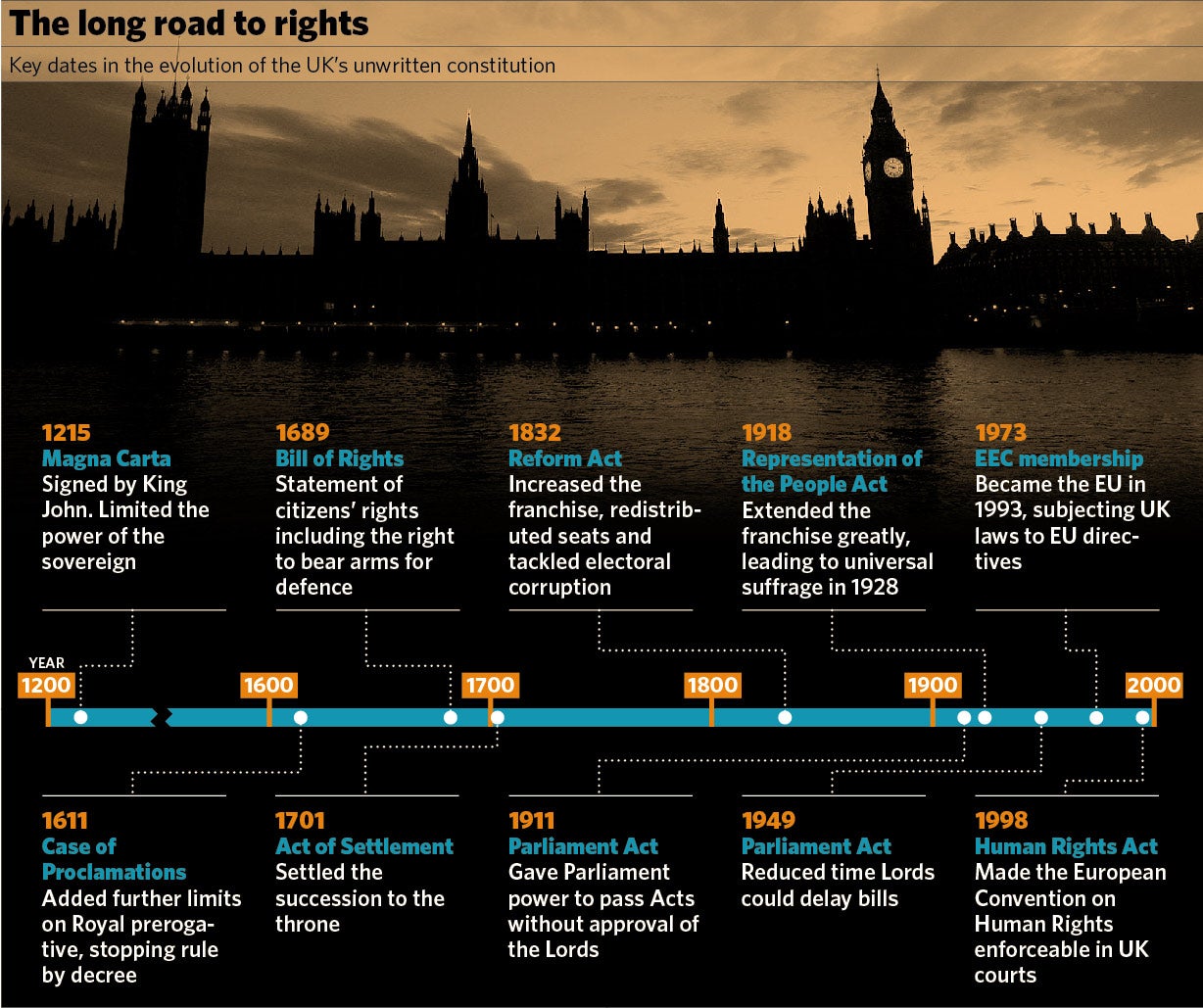
The key milestone was the Bill of Rights (1689), which established the supremacy of Parliament over the Crown following the forcible replacement of King James II (r. 1685–88) by William III (r. 1689–1702) and Mary (r. 1689–94) in the Glorious Revolution (1688). Surely enough years have passed since the last changes for it to be time to modernise the UK's democratic system?
From a comparative perspective, the UK has what is known as an ‘unwritten constitution’ (although some prefer to describe it as ‘uncodified’, on the basis that many of the UK’s laws of a constitutional nature are in fact written down in Acts of Parliament or in the law reports of court judgments). This aspect of the British constitution, its unwritten nature, is its most distinguishing characteristic.
And, in the great buffet of life, this is what the UK's unwritten constitution looks like: a salad made from healthy vegetables that somehow politics, money, and the legal actors always manage to ruin with the wrong spices.
Why doesn't the UK have a written constitution?
Essentially because the country has been too stable for too long. The governing elites of many European nations, such as France and Germany, were forced to draw up their constitutions in response to popular revolts or the outcomes of war.
Great Britain, by contrast, remained free of the revolutionary fervour that swept much of the Continent in the 19th century. As a result, this country's democracy has been reformed incrementally over centuries rather than in one big bang.
For younger countries, including the United States and Australia, codification of their citizens' rights and political systems was an essential step towards independence. Ironically, several based their written constitutions on Britain's unwritten version.
What are the disadvantages?
The people who hold the reins of power naturally resist any updates and upgrades to a system that was designed hundreds years ego. The people resisting change may simply be the victimsof bad habits. Habit, like gravity, never takes a day off.
"It it ain't broke, don't fix it," argue opponents of a written constitution, insisting that the existing arrangements, however piecemeal their development has been, have worked well in practice. There are, moreover, formidable practical problems to be overcome before such a document could be drawn up. Would it be wide-ranging and largely abstract or would it list individuals' rights in detail and provide an exhaustive summary of Britain's constitutional settlement? If the latter, it could prove beyond the grasp of most of the citizens it would be designed to protect.
Professor Robert Hazell, the director of the Constitution Unit at University College London, predicted Britain would never get a written constitution. "Constitutions don't get written in cold blood." Nick Herbert, the shadow Justice Secretary, was equally sceptical. "The last thing Britain needs, with 2,000 years of history behind us, is more of New Labour's blind constitutional vandalism," he said.
Should the UK have a written constitution?
Should the UK now take steps to codify all its laws, rules and conventions governing the government of the country into one comprehensive document - a new ‘Magna Carta’? The case for a written UK constitution has been debated at UK universities and by politicians of all parties for several decades, and was the subject of a House of Commons committee inquiry during the 2010–15 Parliament.
The Brexit turmoil, chaos, confusion and disorder is proof that Britain should renounce its governmental primitiveness and adopt an orderly written constitution that regulates the power relations between government institutions and ensure that the supreme ruler of the law is the citizenry rather than the politicians and legal experts whose interests and actions are not necessarily in the public and the kingdom’s interests.
If a written constitution for the future is to be prepared, it must be one that engages and involves everyone, especially young people, and not simply legal experts and parliamentarians. Some of the mystique and charm of an ancient constitution might be lost in the process, but a written constitution could bring the government and the governed closer together, above all by making the rules by which the UK's political democracy operates more accessible and intelligible to all.
Brexit Chaos
On the other side of the Atlantic, the constitutional crisis provoked by Boris Johnson’s decision to suspend the British parliament led to confusion, intrigue, and a certain amount of gloating.
In the US, it was argued, this couldn’t happen because the Founding Fathers, in all their wisdom, sat down in 1787 and wrote everything down. The US Constitution and the Bill of Rights have been the basis of American politics ever since.
Britain, by contrast, is one of only a handful of nations that has an uncodified constitution. While it is often described as unwritten, that is not strictly true: the UK is governed by statutes, laws and precedents that date back hundreds of years. They’re just not all in the same place. Like a very large, very well-shuffled deck of cards. More often than not, this random deck is used to serve the interests of the people in power rather than for the benefit of the country, the monarchy and its citizens. Those holding the deck simply pull out the card which best suits their needs. Sometimes it’s a joker.
Despite Britain being a parliamentary democracy, laws still have to be given Royal Assent by the Queen - and while, theoretically, she could say no, in reality, no monarch has declined to sign a bill since 1708.
Boris Johnson’s critics accused the prime minister of orchestrating a coup last week when he decided to prorogue - or suspend - parliament for around five weeks until mid-October, ahead of the Brexit deadline on October 31.
Johnson - rightly, as it happens - pointed out that as a new prime minister he is perfectly entitled to request a Queen’s speech on October 14, and that it is entirely normal for parliament to be prorogued for between two and five weeks prior to that speech being given.
A legal appeal - one of three - to be filed against the decision was on Friday rejected by the High Court and will now be taken to the Supreme Court. Over the centuries, Britain’s unwritten constitution has been written in the courts - by non-elected officers, if you please - and it is being written again, in the courts,right now.
Now the Opposition, with the backing of 21 Conservative rebels, have voted through legislation (pending Royal Assent) that would require Johnson to ask the EU for an extension of the Brexit deadline. He has said he will refuse. Does he have to? And if he doesn’t - what then?
The problem with an uncodified constitution is that it relies on the parties involved to continue to respect it. If they don’t, a constitutional crisis ensues. If there is a vote of no confidence in Boris Johnson and he refuses to resign, the UK is in uncharted territory, without a map.
“This is fundamental to how the relationship between government and parliament has been understood in the UK,” says Daniel Gover, lecturer in British politics at the Queen Mary University of London, “[but] it is not written down anywhere as a legal requirement.”
'Constitutional outrage'
Green Party MP Caroline Lucas, speaking in parliament this week, said that the events of recent weeks demonstrated - yet again, in her view - that Britain needs a written constitution. She said that suspending parliament was a “constitutional outrage” - and at least some Tories agree.
More recently the speaker of the house, John Bercow, said that a Royal Commission should be set up to explore whether the UK needed a constitution or Bill of Rights.
"We would not be having [this] discussion if we had a remotely codified form of constitution that would be essential in the vast majority of democracies," Bercow said at the annual Bingham lecture in London.
Rebel MP Caroline Nokes, who had the party whip withdrawn, told Euronews that it was the suspension of parliament that provoked her to defy Johnson over Brexit: “People have their members of parliament in order to hold the executive to account,” she said.
Patrick Dunleavy, professor of political science and public policy at the London School of Economics, wrote recently that Britain’s “unfixed constitution” had been exploited to the extent that it was neither a guarantor of democratic responsibility nor a check on executive power.
“A great deal of faith was placed in British elites’ developed respect for parliament, for public opinion and for legality [...] .Precious little now remains of such glib and overly-optimistic voices,” he wrote.
Bottom line:
“Resisting change is like holding your breath. If you succeed, you die.” (Franklin Delano Roosevelt)
In the past 100 years we have revolutionized our world with innovations like automobiles, aeroplanes, computers, mobile phones, antibiotics and nano-technology. But Britain's democratic system of government have made no innovation at all. No progress in 300 years or more. The UK’s Democracy is desperately in need of an upgrade. Because more and more people are losing their trust in the democratic system and are fast turning to alternative ways to manage society. The gap between thought and action, between belief and will, prevents us solving our most pressing individual and societal problems. So this is a wake-upcall, to upgrade and update the UK’s democracy, before we lose it all. I am not suggesting revolution, but a sensible, step by step evolution.
The United Kingdom needs to learn from the civil revolt currently taking place in Hong Kong, and to avoid pushing its citizens into a similar state of despair, with them losing confidence in government institutions and losing trust in Parliament's commitment to uphold voter will.
The big question, of course, is how the UK could even begin to put a new constitution together.
When James Madison led the drafting of the US constitution in 1787, America was a country of four million people - the UK today is closer to 70 million.But more important than that, the UK is a country that is irreconcilably divided, with a parliament that for three years has been unable to agree on a path forward, andopposing political parties with huge ideological differences.
How could it now sit down and hash out a document that should govern the nation for decades, centuries, millennia?