

Top EU diplomats step up criticism of China’s crackdown on Hong Kong
The European Union escalated its criticism of Beijing’s political crackdown on Hong Kong on Monday, but stopped short of rolling out major sanctions on the city’s officials for the continued squeeze on opposition figures.
Hong Kong was high on the agenda of the meeting of the EU’s Foreign Affairs Council, comprising the bloc’s 27 foreign ministers and senior EU officials, with Brussels’ top diplomat, Josep Borrell, referring a situation in the city that “keeps deteriorating”.
At a press conference after the meeting, Borrell confirmed agreement on a “two-step process” that will be added to the previous response package to the national security law imposed on Hong Kong last summer, which was rolled out last July.
“The first step involves measures designed to increase support to civil society, including coordination with like-minded parties and outreach to relevant authorities,” Borrell said.
Further steps will be taken in case of “further deterioration in the situation, such as aggressive reform of the electoral process in Hong Kong or further erosion of the independence of the judiciary”, Borrell said, without specifying what the steps might be.
Concerns continued to be stoked about the waning prospects of free and open elections on Monday, after Xia Baolong, director of the State Council’s Hong Kong and Macau Affairs Office, declared that the city’s administrative, legislative and judicial branches, as well as its more than 260 statutory bodies, must be led by “true patriots”.
Borrell welcomed the involvement of US Secretary of State Antony Blinken, who joined the last two hours of the Foreign Affairs Council (FAC), earmarking China and Russia as potential areas for collaboration.
“We discussed opportunities and challenges in relations with China and Russia, which are the two poles with respect, we have to face the most important challenges,” Borrell said.
In a US readout of the meeting, State Department spokesman Ned Price said Blinken had “highlighted the United States’ commitment to repairing, revitalising and raising the level of ambition in the US-EU relationship”.
“During the FAC, the secretary, High Representative Borrell and EU member state foreign ministers discussed our joint response to pressing global issues, including Covid-19, Iran, China and climate change, and the secretary welcomed the EU‘s decision to impose sanctions against Russia under the human rights sanctions regime in response to actions taken against Alexei Navalny and his supporters,” Price added, referring to the Kremlin critic’s poisoning, arrest and sentencing.
The ministers also agreed on targeted sanctions against military figures behind the coup in Myanmar.
 Kremlin critic Alexei Navalny appears at a court hearing in Moscow on Saturday.
Before the meeting, senior EU officials had warned about Hong Kong’s “deteriorating” situation, in reference to “internal freedom”, while a non-paper – an unofficial diplomatic note – had been circulated among member states proposing new measures in response to the situation.
But rather than a dramatic overhaul of existing EU policy towards Hong Kong, the bloc plans to continue implementing those unveiled in July. These included export controls, observations of the trials of pro-democracy activists, assessing the risks to EU citizens presented by the national security law, and not entering any new negotiations with Hong Kong.
The continued focus on Hong Kong followed a video meeting on Friday between senior officials from the EU and Hong Kong Security Bureau and the Constitutional and Mainland Affairs Bureau.
The call involved “frank exchanges on the implementation of the national security law, the arrest and prosecution of pro-democracy activists, and the upcoming Legislative Council elections, including timing, disqualification of candidates, eligibility to vote and electoral reform”, said Nabila Massrali, EU spokeswoman for foreign affairs and security policy.
A Hong Kong government spokesman confirmed the meeting with the European External Action Service (EEAS) but would not disclose further details.
“Nevertheless, we should stress that law enforcement agencies are duty-bound to take action against unlawful acts, regardless of the political beliefs or background of the suspects. Arrests made are based on evidence and strictly in accordance with relevant laws and regulations,” the spokesman said.
Despite the new administration in Washington and senior EU figures voicing hope for a renewed transatlantic alliance, the EU has looked to pursue an autonomous set of policies on China.
It signed the Comprehensive Agreement on Investment (CAI) in late December, much to the chagrin of some European politicians and analysts, who had hoped for more alignment with the Biden administration, which began three weeks later.
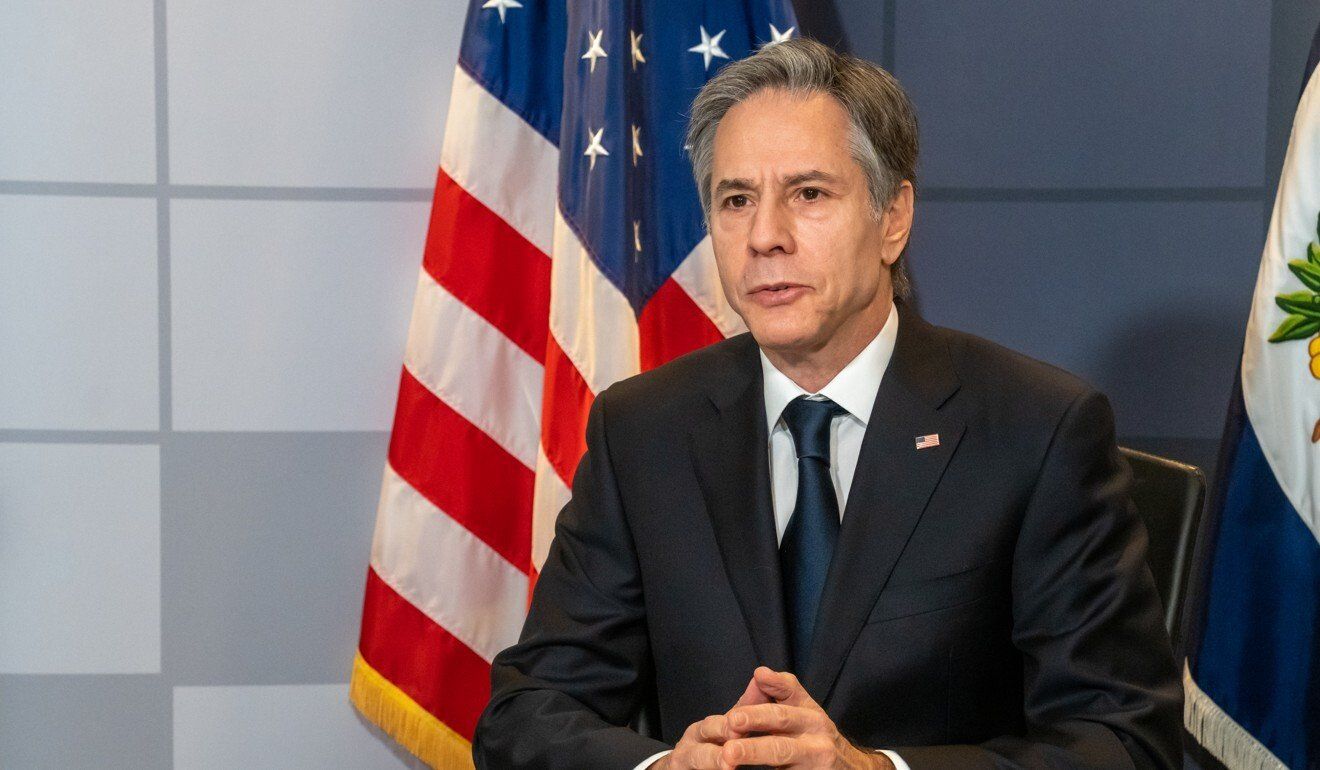 US Secretary of State Antony Blinken participates in a video teleconference with the EU Foreign Affairs Council on Monday.
Borrell defended the two-track approach to Brussels’ relationship with Beijing, saying that signing the agreement “does not prevent us from continuing addressing with China our concerns about human rights and fundamental freedoms”.
“I think that this makes it quite an important difference between the approaches or attitudes of China, and Russia,” he added, referring to Moscow as a “neighbour who unfortunately seems to have decided to act as an adversary”.
Since signing the CAI on December 30, a cavalcade of reports have helped turn the spotlight on China’s human rights record in Hong Kong and Xinjiang and led to some questions about ratification in the European Parliament.
“A few days after signing, you had 50-plus arrests in Hong Kong of pro-democracy figures. That was really a slap in the face, really. But the message we hear from people on the inside is that the toolbox is still there. The fact that there is a negotiation on the CAI does not mean we are not going to speak out on Hong Kong,” said Philippe Le Corre, a China specialist at the Carnegie Endowment for International Peace.
Blinken’s appearance – welcomed in a series of statements by EU member state foreign ministers – was part of a flurry of diplomatic appearances from the Biden administration in recent days, in a signal to allies that the US has returned to the multilateral table.
Addressing the Munich Security Conference on Friday, Biden himself urged Europe and other allies to “prepare together for long-term strategic competition with China”.
“Competition with China is going to be stiff; that is what I expect, and that is what I welcome. Because I believe in the global system, Europe and the United States together, with our allies in the Indo-Pacific worked so hard to build over the last 70 years,” Biden said.
Analysts said that while the EU may be happy to work with the US on China issues elementally, it will continue to maintain its strategic autonomy.
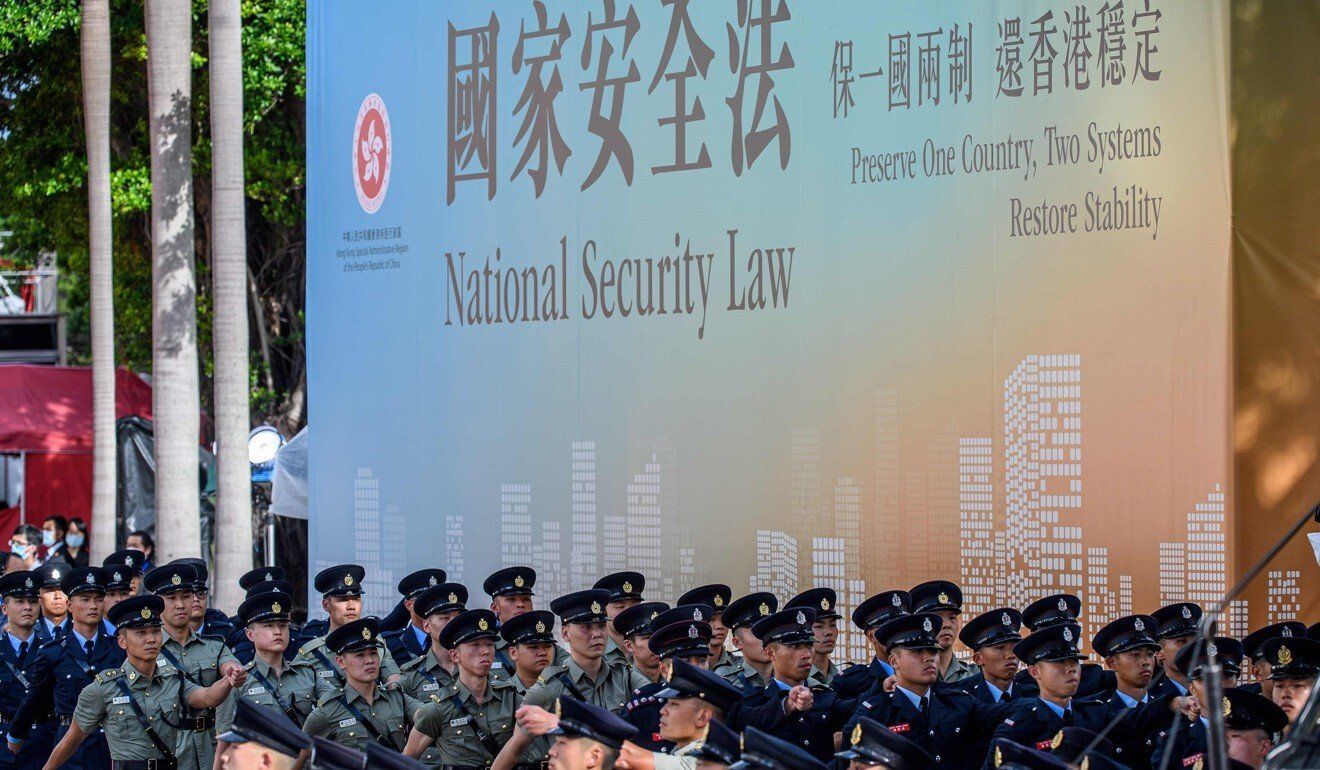 A banner supporting the national security law imposed on Hong Kong was displayed on July 1.
“The EU at large is not inclined to join the US in a ‘long-term strategic confrontation’ with China understood as a geopolitical stand-off. Instead, it remains committed to its own compartmentalised approach of dealing with China. Within this logic it would prefer to initiate the transatlantic cooperation on China as a technocratic framework for dealing with concrete issues with surgical precision – at least at this stage,” said Grzegorz Stec, an analyst at the Berlin-based Mercator Institute for China Studies.
Across the West, pressure on China regarding its human rights record has been growing.
On Monday, British Foreign Minister Dominic Raab said, in a speech to the UN Human Rights Council: “In Hong Kong, the rights of the people are being systematically violated. The national security law is a clear breach of the Sino-British Joint Declaration and is having a chilling effect on personal freedoms.”
Earlier in the day in a speech in Beijing, Chinese Foreign Minister Wang Yi called on the West to stop “undermining China’s sovereignty and security on internal affairs concerning Hong Kong, Xinjiang and Tibet”.