

UK government in talks over expanding Covid travel 'red list'
Discussions are under way in Whitehall about expanding the travel “red list” of countries as ministers face mounting pressure to prevent coronavirus variants undermining the vaccine programme.
The Guardian understands that officials met on Friday to consider the case for taking a tougher approach. British residents and nationals returning from countries on the red list must quarantine in an airport hotel for 10 days at a cost of £1,750, while other arrivals are banned. It remains illegal to go on holiday.
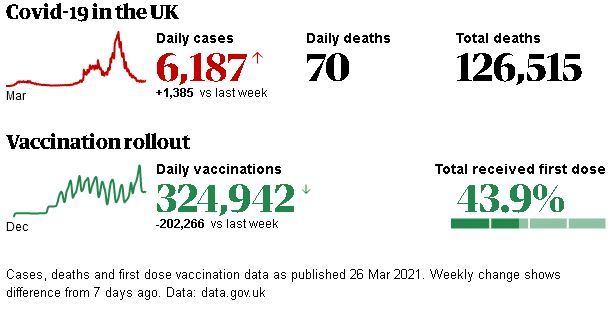
Ministers are expected to take a decision next week against the backdrop of rising Covid cases across parts of Europe. In the UK, the case rate per 100,000 people for the past two weeks is 114, according to data published by the European Centre for Disease Prevention and Control. The same rates are far higher in large parts of the continent, with Poland on 716, France on 562 and Italy on 517.
From Sunday, anyone travelling from France to Germany will have to submit a negative test and go into 10 days’ quarantine.
One insider said: “It’s getting to the point where it’s not really sustainable to not respond to that.” They suggested there could be “quite a few additions” to the red list – which currently includes 35 countries including Brazil and the UAE – and that the threat of variants being imported and then being spread by community transmission was “definitely part of the thinking”.
“It’s very different to last summer when it was just about cases,” they said. “We can’t have variants coming in that could potentially affect the vaccine rollout.”
Official data published by the UK government on Thursday showed 412 cases of the variant first identified in South Africa had been found in the UK so far. This is the variant causing most anxiety among ministers because some studies have suggested it may be partially resistant to vaccines.
A Department of Health and Social Care source said: “We’re keeping a very close eye on it … it is of concern, and that needs to be fed into all the other elements that need to be considered when you’re looking at the red list.”
Other government sources played down the likelihood of changes to the red list, however, stressing in particular that close trade ties across the Channel would make a crackdown on France very difficult. Ministers are expected to announce increased testing of freight drivers arriving from France in the coming days in an attempt to reduce the risk of variants arriving by that route.
Earlier this week Boris Johnson was pressed by the Labour MP Yvette Cooper on why tougher measures had not been taken to prevent the South African variant arriving. He said adding France to the red list was “something that we will have to look at” but underlined the difficulties of doing so.
Government experts are confident that so far there is no widespread community transmission of the South African variant, with most cases traced back to travel. But concerns have intensified ahead of the next stage of the easing of Covid restrictions in England, which from Monday will allow more outdoor mixing and could let mutations spread more rapidly if they do take hold.
At the beginning of March, Matt Hancock, the health secretary, resisted calls to add more countries to the red list despite news that the Brazil variant, which is believed to be more infectious, had been found in 15 more countries. At the time, he said that was because the proportion of variants of concern found in those countries relative to total cases was “exceptionally low”.
But Johnson said this week that “on the continent right now you can see sadly there is a third wave under way”, and government figures are deliberating how to avoid it hitting UK shores.
Ministers face a series of key decisions in the coming weeks on issues that were set aside when the roadmap was published – including whether holiday travel abroad can resume in the summer, from 17 May at the earliest.
A global travel taskforce chaired by the transport secretary Grant Shapps is due to publish its first report on 5 April. Government sources say it is likely to set the framework for a resumption of some travel but may not yet set specific dates.
One option is a three-tier traffic light system, segregating countries according to how prevalent Covid is and whether they have a vaccination certification system.
A separate review chaired by the Cabinet Office minister, Michael Gove, is considering how the UK can introduce its own Covid certification system, which could be used to facilitate travel but also to control entry to venues such as pubs and sports stadiums.
Hancock and Gove are both more cautious about reopening the borders in summer, according to colleagues, with the health secretary arguing that the tougher the UK’s travel restrictions are, the more relaxed the rules can be at home. “We need to think very carefully about it,” said an ally of Gove.
A Downing Street source stressed that it remained illegal to go on holiday and as a result travel flows were still well below normal, and all arrivals had to show evidence of a negative test and must self-isolate.