Arab Press

بالشعب و للشعب
Monday, Dec 15, 2025

'Historic' G7 deal to stop global corporate tax avoidance welcomed by tech giants Google and Facebook

'Historic' G7 deal to stop global corporate tax avoidance welcomed by tech giants Google and Facebook

"It's a proud moment," says Chancellor Rishi Sunak as G7 finance ministers commit to a global minimum tax of at least 15%.


Google and Facebook have welcomed a G7 deal on tackling corporate tax avoidance by big tech companies.

The agreement will see a global minimum corporate tax of at least 15% - lower than a floor of 21% mooted by President Biden - and changes to which countries will benefit.

Chancellor Rishi Sunak called the deal "a proud moment".

Speaking after two days of talks in London, he added it "meant the right companies pay the right tax in the right places".

The changes would ensure major corporations, especially those with a strong online presence, will pay taxes in the countries where they operate and not only where they have headquarters.

Rich nations have struggled for years to agree a way to raise more revenue from large multinationals such as Google, Amazon and Facebook, which often book profits in jurisdictions where they pay little or no tax.

After the announcement Nick Clegg, vice president of global affairs at Facebook said: "We want the international tax reform process to succeed and recognize this could mean Facebook paying more tax, and in different places."


A Google spokesperson said the company strongly supports the initiative and hoped for a "balanced and durable" agreement.

Sky's economics and data editor Ed Conway said: "This is about trying to prevent billions of dollars, if not trillions, of tax avoidance by the world's biggest companies.

"At the moment taxes are mostly based on profit but you can shift those profits far more easily than you can your sales".

Companies with a profit margin over 10% would have a portion of tax taken above that level, which is then reallocated on the basis of sales to different countries around the world.

"That is equally, if not more of a big deal, than the global minimum," Conway added.

"Put those two things together and you have perhaps the most convincing attempt at trying to deal internationally with what's going on with the tech giants and their tax payments.

"The work to try and get this done has been going on for some years, if not decades.

"On the other hand it's easy to be sceptical and the rate - 15% - is a lot lower than it was originally expected to be. It was originally going to be 21%, so the target is less ambitious."

A Treasury spokeswoman explained that the most profitable multinationals would have to pay tax in the countries where they operate and not just where their headquarters are.

"The fairer system will mean the UK will raise more tax revenue from large multinationals and help pay for public services here in the UK," she said.

Mr Sunak said there had been "huge progress" on an issue that had been discussed for nearly a decade.

The agreement is now set to be looked over in more detail at the G20 financial ministers and Central Bank governors meeting in July.
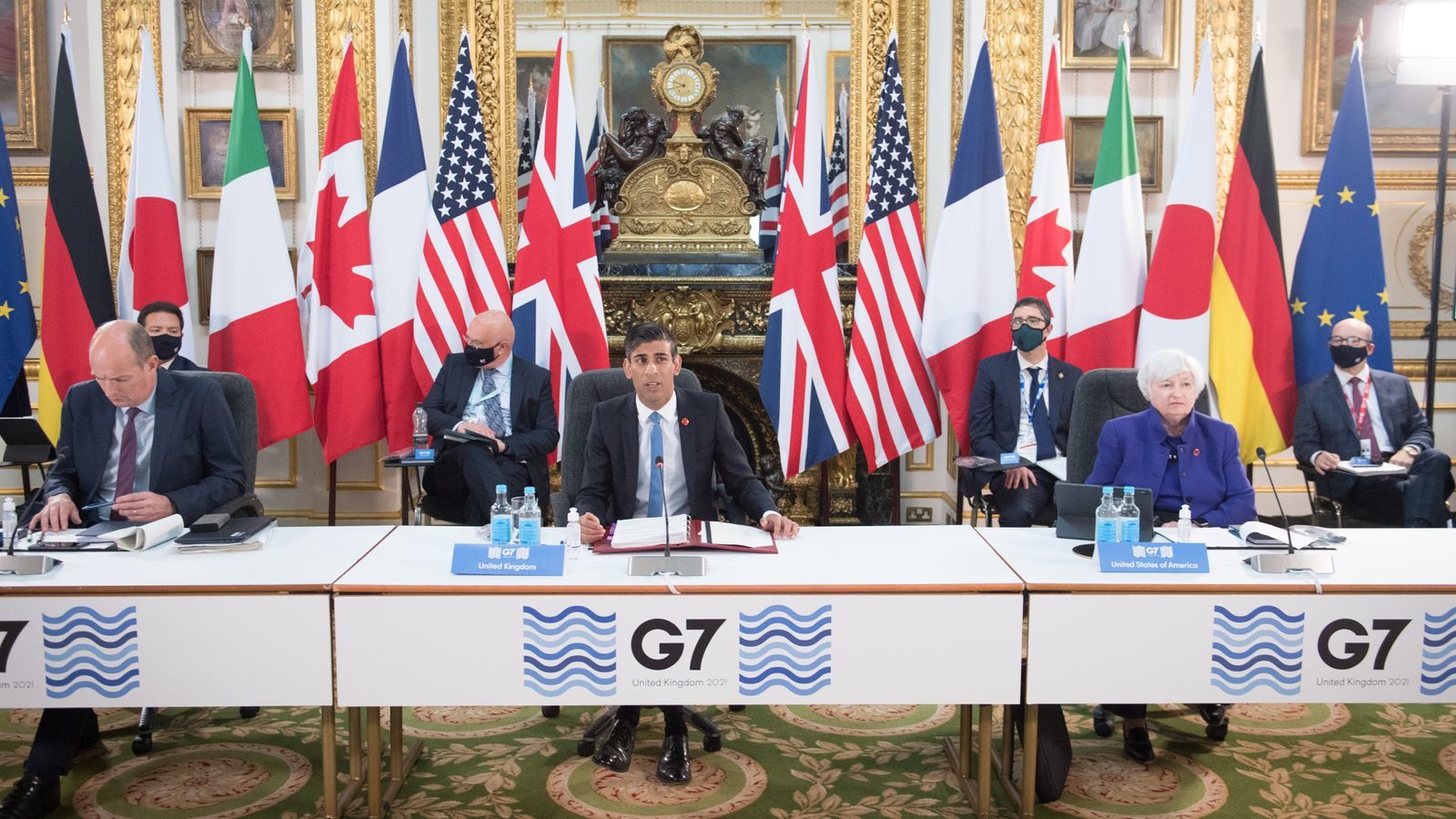
Chancellor Rishi Sunak at a meeting of finance ministers from across the G7 nations


The deal is likely to cause tensions with Ireland, as it has so far been unwilling to raise its corporation tax rate above 12.5%.

Ireland's finance minister Paschal Donohoe tweeted: "I note the joint position by #G7 finance ministers on international corporate taxation. It is in everyone's interest to achieve a sustainable, ambitious and equitable agreement on the international tax architecture.

"I look forward now to engaging in the discussions at @OECD. There are 139 countries at the table, and any agreement will have to meet the needs of small and large countries, developed and developing."

Meanwhile, Labour called on the government to push for more than the 15% base rate, after US President Joe Biden had initially wanted a 21% minimum, which the party said would raise £131m for public services.

"This government must now show leadership, push for a 21% rate in negotiations, and use the money to fund our schools and our NHS," said shadow chancellor Rachel Reeves.

The Adam Smith Institute - a pro-free market think tank - said the chancellor had effectively tied his own hands while handing "power over our taxes to Washington's demands".

"These proposals are not in the UK's interest and Rishi has sold Britain short," said deputy director Matt Kilcoyne.

"Rishi Sunak's flagship policies of super deductions and free ports are dead in the water. The chancellor's own policies, scuppered by his own hubris."

Newsletter

Related Articles

Arab Press
0:00
0:00
Close
Saudi Arabia Condemns Sydney Bondi Beach Shooting and Expresses Solidarity with Australia
Washington Watches Beijing–Riyadh Rapprochement as Strategic Balance Shifts
Saudi Arabia’s Vision 2030 Drives Measurable Lift in Global Reputation and Influence
Alcohol Policies Vary Widely Across Muslim-Majority Countries, With Many Permitting Consumption Under Specific Rules
Saudi Arabia Clarifies No Formal Ban on Photography at Holy Mosques for Hajj 2026
Libya and Saudi Arabia Sign Strategic MoU to Boost Telecommunications Cooperation
Elon Musk’s xAI Announces Landmark 500-Megawatt AI Data Center in Saudi Arabia
Israel Moves to Safeguard Regional Stability as F-35 Sales Debate Intensifies
Cardi B to Make Historic Saudi Arabia Debut at Soundstorm 2025 Festival
U.S. Democratic Lawmakers Raise National Security and Influence Concerns Over Paramount’s Hostile Bid for Warner Bros. Discovery
Hackers Are Hiding Malware in Open-Source Tools and IDE Extensions
Traveling to USA? Homeland Security moving toward requiring foreign travelers to share social media history
Wall Street Analysts Clash With Riyadh Over Saudi Arabia’s Deficit Outlook
Trump and Saudi Crown Prince Cement $1 Trillion-Plus Deals in High-Profile White House Summit
Saudi Arabia Opens Alcohol Sales to Wealthy Non-Muslim Residents Under New Access Rules
U.S.–Saudi Rethink Deepens — Washington Moves Ahead Without Linking Riyadh to Israel Normalisation
Saudi Arabia and Israel Deprioritise Diplomacy: Normalisation No Longer a Middle-East Priority
As Trump Deepens Ties with Saudi Arabia, Push for Israel Normalization Takes a Back Seat
Thai Food Village Debuts at Saudi Feast Food Festival 2025 Under Thai Commerce Minister Suphajee’s Lead
Saudi Arabia Sharpens Its Strategic Vision as Economic Transformation Enters New Phase
Saudi Arabia Projects $44 Billion Budget Shortfall in 2026 as Economy Rebalances
OPEC+ Unveils New Capacity-Based System to Anchor Future Oil Output Levels
Hong Kong Residents Mourn Victims as 1,500 People Relocated After Devastating Tower Fire
Saudi Arabia’s SAMAI Initiative Surpasses One-Million-Citizen Milestone in National AI Upskilling Drive
Saudi Arabia’s Specialty Coffee Market Set to Surge as Demand Soars and New Exhibition Drops in December
Saudi Arabia Moves to Open Two New Alcohol Stores for Foreigners Under Vision 2030 Reform
Saudi Arabia’s AI Ambitions Gain Momentum — but Water, Talent and Infrastructure Pose Major Hurdles
Tensions Surface in Trump-MBS Talks as Saudi Pushes Back on Israel Normalisation
Saudi Arabia Signals Major Maritime Crack-Down on Houthi Routes in Red Sea
Italy and Saudi Arabia Seal Over 20 Strategic Deals at Business Forum in Riyadh
COP30 Ends Without Fossil Fuel Phase-Out as US, Saudi Arabia and Russia Align in Obstruction Role
Saudi-Portuguese Economic Horizons Expand Through Strategic Business Council
DHL Commits $150 Million for Landmark Logistics Hub in Saudi Arabia
Saudi Aramco Weighs Disposals Amid $10 Billion-Plus Asset Sales Discussion
Trump Hosts Saudi Crown Prince for Major Defence and Investment Agreements
Families Accuse OpenAI of Enabling ‘AI-Driven Delusions’ After Multiple Suicides
Riyadh Metro Records Over One Hundred Million Journeys as Saudi Capital Accelerates Transit Era
Trump’s Grand Saudi Welcome Highlights U.S.–Riyadh Pivot as Israel Watches Warily
U.S. Set to Sell F-35 Jets to Saudi Arabia in Major Strategic Shift
Saudi Arabia Doubles Down on U.S. Partnership in Strategic Move
Saudi Arabia Charts Tech and Nuclear Leap Under Crown Prince’s U.S. Visit
Trump Elevates Saudi Arabia to Major Non-NATO Ally Amid Defense Deal
Trump Elevates Saudi Arabia to Major Non-NATO Ally as MBS Visit Yields Deepened Ties
Iran Appeals to Saudi Arabia to Mediate Restart of U.S. Nuclear Talks
Musk, Barra and Ford Join Trump in Lavish White House Dinner for Saudi Crown Prince
Lawmaker Seeks Declassification of ‘Shocking’ 2019 Call Between Trump and Saudi Crown Prince
US and Saudi Arabia Forge Strategic Defence Pact Featuring F-35 Sale and $1 Trillion Investment Pledge
Saudi Sovereign Wealth Fund Emerges as Key Contender in Warner Bros. Discovery Sale
Trump Secures Sweeping U.S.–Saudi Agreements on Jets, Technology and Massive Investment
Detroit CEOs Join White House Dinner as U.S.–Saudi Auto Deal Accelerates
×