Arab Press

بالشعب و للشعب
Wednesday, Jan 28, 2026

World Cup Iran-US: Why Iran gave the US players flowers in 1998

World Cup Iran-US: Why Iran gave the US players flowers in 1998

Amid harsh barbs and heated geopolitics, the last World Cup match-up between Iran and the United States began with an unlikely gesture - bouquets of white flowers.

The flowers, Iran's coach later said, were meant as a symbol of peace ahead of the 1998 showdown in France.

Two decades later, political tensions were again high ahead of the Iran-US game in Qatar.

The latest meeting, however, went without any friendly gestures.

The previous match, held in Lyon, came 20 years after diplomatic relations between the two nations were severed as a result of the storming of the US embassy in Tehran in 1979 and subsequent 444 day hostage crisis.

Just one month before kick-off, the US State Department labelled Iran the world's "most active" state sponsor of terrorism, while several high-level Iranian officials kept up a steady drumbeat of anti-US rhetoric.

Despite the tensions evident in the halls of the United Nations and in the Persian Gulf, Iran's players - led by California-based manager Jalal Talebi - decided to start the match with a signal that the only competition between the two would be on the pitch.

"We decided to make something special," Mr Talebi said in an oral history of the match produced by ESPN.

"Let us go inside and give them nice flowers to say that we are here for peace. We are not here for fighting or anything."

The US team reciprocated, giving their opponents US Soccer Federation (USSF) pennants. Together, the squads posed for a group picture, with many of the players smiling ahead of the high-pressure match.
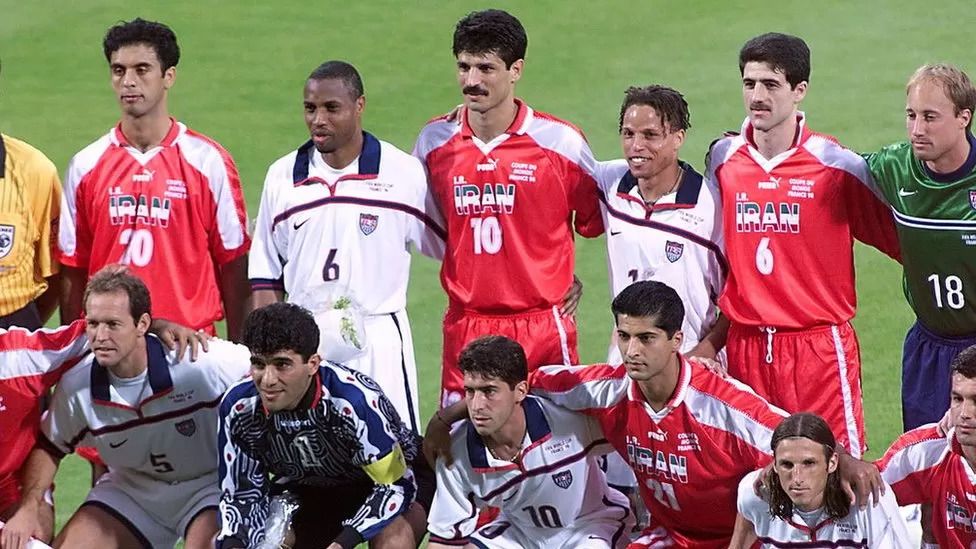

While the game ended in a 2-1 win for Iran, neither team advanced past the group stage.

"I thought that was great," Cobi Jones, then a midfielder for the US team, said in the ESPN report.

"It's just like a sign of like sport trumping politics and all that. That was very important and having the mixed photo was great."

The days leading up to the World Cup rematch on Tuesday between the two teams were once again marked by tensions, coming amid widespread anti-government protests in Iran and just after the USSF removed the emblem of the Islamic Republican from the flag it posted in online graphics.

The pictures were later deleted, and US manager Gregg Berhalter apologised, saying that "sometimes things are out of our control" and that he and the US team were only focused on football.

The US team went into the match hoping to avoid a repeat of the 1998 game, which ended with a 2-1 victory for Iran, though both countries were eliminated from the tournament after the game.

Alexi Lalas, a Fox Sports commentator who was a member of the 1998 team, told the Associated Press that the current US team would be well advised not to ignore the wider geopolitics surrounding the current match.

"Understanding the importance of this game, not just from a soccer perspective but from a cultural perspective, I think is crucial for the United States," he said, addressing what would motivate the US on the pitch.

The US-Iran match in Qatar ended 1-0 in the Americans' favour after a goal from Christian Pulisic in the 38th minute.


Watch: Iran football manager Carlos Queiroz confronts BBC correspondent Shaimaa Khalil


Newsletter

Related Articles

Arab Press
0:00
0:00
Close
Saudi Crown Prince Tells Iranian President: Kingdom Will Not Host Attacks Against Iran
U.S. Central Command Announces Regional Air Exercise as Iran Unveils Drone Carrier Footage
Trump Defends Saudi Crown Prince in Heated Exchange After Reporter Questions Khashoggi Murder and 9/11 Links
Saudi Stocks Rally as Kingdom Prepares to Fully Open Capital Market to Global Investors
Air France and KLM Suspend Multiple Middle East Routes as Regional Tensions Disrupt Aviation
Saudi Arabia scales back Neom as The Line is redesigned and Trojena downsized
Saudi Industrial Group Completes One Point Three Billion Dollar Acquisition of South Africa’s Barloworld
Saudi-Backed LIV Golf Confirms Return to Trump National Bedminster for 2026 Season
Gold Jumps More Than 8% in a Week as the Dollar Slides Amid Greenland Tariff Dispute
Boston Dynamics Atlas humanoid robot and LG CLOiD home robot: the platform lock-in fight to control Physical AI
United States under President Donald Trump completes withdrawal from the World Health Organization: health sovereignty versus global outbreak early-warning access
Trump Administration’s Iran Military Buildup and Sanctions Campaign Puts Deterrence Credibility on the Line
Tech Brief: AI Compute, Chips, and Platform Power Moves Driving Today’s Market Narrative
NATO’s Stress Test Under Trump: Alliance Credibility, Burden-Sharing, and the Fight Over Strategic Territory
Saudi Arabia’s Careful Balancing Act in Relations with Israel Amid Regional and Domestic Pressures
Greenland, Gaza, and Global Leverage: Today’s 10 Power Stories Shaping Markets and Security
America’s Venezuela Oil Grip Meets China’s Demand: Market Power, Legal Shockwaves, and the New Rules of Energy Leverage
Trump’s Board of Peace: Breakthrough Diplomacy or a Hostile Takeover of Global Order?
Prince William to Make Official Visit to Saudi Arabia in February
Saudi Arabia Advances Ambitious Artificial River Mega-Project to Transform Water Security
Saudi Crown Prince and Syrian President Discuss Stabilisation, Reconstruction and Regional Ties in Riyadh Talks
Mohammed bin Salman Confronts the ‘Iranian Moment’ as Saudi Leadership Faces Regional Test
Cybercrime, Inc.: When Crime Becomes an Economy. How the World Accidentally Built a Twenty-Trillion-Dollar Criminal Economy
Strategic Restraint, Credible Force, and the Discipline of Power
Donald Trump Organization Unveils Championship Golf Course and Luxury Resort Project in Saudi Arabia
Inside Diriyah: Saudi Arabia’s $63.2 Billion Vision to Transform Its Historic Heart into a Global Tourism Powerhouse
Trump Designates Saudi Arabia a Major Non-NATO Ally, Elevating US–Riyadh Defense Partnership
Trump Organization Deepens Saudi Property Focus with $10 Billion Luxury Developments
There is no sovereign immunity for poisoning millions with drugs.
Mohammed bin Salman’s Global Standing: Strategic Partner in Transition Amid Debate Over His Role
Saudi Arabia Opens Property Market to Foreign Buyers in Landmark Reform
The U.S. State Department’s account in Persian: “President Trump is a man of action. If you didn’t know it until now, now you do—do not play games with President Trump.”
CNN’s Ranking of Israel’s Women’s Rights Sparks Debate After Misleading Global Index Comparison
Saudi Arabia’s Shifting Regional Alignment Raises Strategic Concerns in Jerusalem
OPEC+ Holds Oil Output Steady Amid Member Tensions and Market Oversupply
Iranian Protests Intensify as Another Revolutionary Guard Member Is Killed and Khamenei Blames the West
President Trump Says United States Will Administer Venezuela Until a Secure Leadership Transition
Delta Force Identified as Unit Behind U.S. Operation That Captured Venezuela’s President
Saudi-UAE Rift Adds Complexity to Middle East Diplomacy as Trump Signals Firm Leadership
OPEC+ to Keep Oil Output Policy Unchanged Despite Saudi-UAE Tensions Over Yemen
Saudi Arabia and UAE at Odds in Yemen Conflict as Southern Offensive Deepens Gulf Rift
Abu Dhabi ‘Capital of Capital’: How Abu Dhabi Rose as a Sovereign Wealth Power
Diamonds Are Powering a New Quantum Revolution
Trump Threatens Strikes Against Iran if Nuclear Programme Is Restarted
Why Saudi Arabia May Recalibrate Its US Spending Commitments Amid Rising China–America Rivalry
Riyadh Air’s First Boeing 787-9 Dreamliner Completes Initial Test Flight, Advancing Saudi Carrier’s Launch
Saudi Arabia’s 2025: A Pivotal Year of Global Engagement and Domestic Transformation
×