
How Israel's Expansion into Syria Uprooted Families and Undermined Regional Stability
Following Bashar Assad's regime collapse in December, Israeli troops entered southern Syria's Quneitra province, leading to widespread abuses against civilians.
LONDON: Almost immediately after the collapse of Bashar Assad’s regime on Dec. 8 last year, Israeli troops entered southern Syria’s Quneitra province and began raiding properties.
Residents recall their homes shaking as armored vehicles rolled through their normally quiet villages and troops took control of areas close to the disputed border with Israel.
"It was clear from their behavior that they intended to stay," one woman from Al-Hamidiyah village said, recalling the day Israeli soldiers raided her home.
She told researchers from the New York-based Human Rights Watch that soldiers pointed their guns at her and her two daughters.
They also forced her husband and son into another room at gunpoint.
"My daughters and I were held like that from 11 a.m. to 3 p.m. My husband and son weren’t released until 11 p.m".
she said.
"The soldiers sat in our living room, laughing and speaking a language we didn’t understand, as if it were their house".
Following Assad’s ousting in a rapid rebel offensive, Israel moved quickly to exploit the power vacuum.
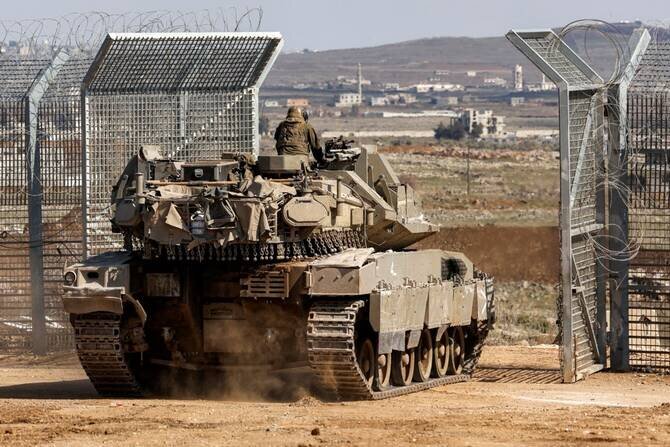
Its forces advanced deep into the UN-monitored demilitarized zone separating the occupied Golan Heights from the rest of Syria.
Soon, Israeli troops established nine military posts stretching from Mount Hermon through Quneitra city to parts of western Daraa.
The HRW documented widespread abuses against civilians in a report published on Sept. 17.
In Al-Hamidiyah, a village in the countryside of Quneitra, Israeli troops reportedly demolished at least 12 buildings on June 16, displacing eight families, to establish a military installation.
But residents said expulsions began the same day Assad’s government fell.
"Our house was closest to the military post, so it was first to be demolished," one villager told the HRW.
"The land surrounding it, which we had planted with trees, was completely bulldozed along with the house".
"Nothing was left," he added.
"We’ve been living under extremely difficult conditions ever since we lost our home and land".
US President Donald Trump meets with Syrian President Ahmed Al-Sharaa in Riyadh.
(SPA)
As the months passed, tensions continued to escalate.
On Oct. 18, Israeli forces set up a checkpoint on the road linking Ofania and Jubata Al-Khashab, where they allegedly intimidated and assaulted civilians, according to the Syrian state-run Alikhbaria TV. Nearly three days later, Israeli forces raided Al-Hamidiyah again to conduct excavation work, Syria’s state news agency SANA reported on Oct. 22.
They were accompanied by heavy machinery, including drilling rigs and bulldozers.
Nearby, in the town of Jubata Al-Khashab, Israeli forces reportedly cleared further tracts of land — including a century-old forest reserve — to build another military installation.
The HRW also documented severe restrictions that cut residents off from their farmland and grazing areas.
Locals said troops bulldozed or fenced off agricultural plots, groves, and pastures.
"We own agricultural land with a total area of 50 dunams (5 hectares)," one woman said.
"Part of it was cultivated with wheat or barley, while the other part was used for grazing sheep".
She told the HRW that Israeli forces built a high earthen berm that blocked access to the entire property and placed it under military control.
The HRW report detailed arbitrary arrests and the transfer of detainees into Israel, including a 17-year-old from Jubata Al-Khashab arrested in April and held without charge.
Shortly after midnight on June 12, Israeli forces, backed by armored vehicles, heavy equipment, and police dogs, raided the village of Beit Jinn in the Damascus countryside, 3 kilometers east of the disengagement line.
Residents told the HRW that soldiers arrested seven men and killed another who had cognitive disabilities.
The Israeli military told Reuters the detainees belonged to Hamas and were planning "multiple terror plots" against Israeli civilians and troops in Syria.
It said the men were transferred into Israel for further interrogation.
Syria’s Interior Ministry rejected the claim, saying those arrested were local civilians, not Hamas members.
The ministry condemned the raid, which lasted around 45 minutes, as a "blatant violation" of Syria’s sovereignty.
The HRW said Israel’s forced displacements, home demolitions and land seizures constitute war crimes under international law.
"Israel’s documented actions in southern Syria violated the laws of war," the monitor added.
The Israeli military, however, maintains that its operations comply with international law.
It described the demolitions as "necessary operational measures," claiming no civilians lived in the affected buildings.
INNUMBERS
• 8 SYRIANS ARRESTED BY THE IDF AND TRANSFERRED TO ISRAEL SINCE DECEMBER.
• 9 NEW ISRAELI MILITARY POSTS ESTABLISHED FROM MOUNT HERMON THROUGH QUNEITRA TO WESTERN DARAA.
The HRW said these actions were part of a broader strategy to entrench Israel’s military presence in southern Syria — a view seemingly confirmed by Israeli officials.
In August, Israel’s Defense Minister Israel Katz said Israeli troops "will remain on the summit of (Mount) Hermon and in the security zone that is vital to defending communities in the region".
OPINION
This section contains relevant reference points, placed in (Opinion field)
"By seizing more Syrian territory, demolishing homes, and depriving farmers of their livelihoods, Israel is setting itself and the region up for another round of wars and regional conflict," Hawach warned.
He added that "the international community has accepted this imbalance and fails to do anything about it despite the heavy future price that is obvious to all".
Since Oct. 7, 2023, Israel has carried out strikes in Iran, Lebanon, Syria, Yemen, and even Qatar, while continuing its war in Gaza and intensifying its occupation of the West Bank.
In Syria alone, Israel’s air force and navy carried out more than 350 strikes within the first two days of Assad’s fall, destroying roughly 80 percent of the country’s strategic military arsenal.
The attacks continued for months afterward.
"Israel’s occupation of southern Syria is a deliberate strategy to prevent the consolidation of a unified Syrian state," Nanar Hawach, a senior Syria analyst at the International Crisis Group, told Arab News.
"This policy of managed instability aims to create a permanent buffer zone and a controlled ‘border society,’ which secures Israel’s northern frontier on its own terms".
"Beyond the southern borders, Israeli actions create an unstable environment that effectively discourages regional investment needed for economic recovery, prolonging Syria’s fragility," Hawach added.
"This approach, while providing a security advantage for Israel, comes at the cost of Syrian sovereignty and regional stability, trapping the country in a cycle of poverty, political fragility, and instability".
In February, Israeli Foreign Minister Gideon Sa’ar openly advocated a federal Syria composed of autonomous regions — a move analysts warn could deepen internal fragmentation and undermine efforts at national stabilization.
Syrian economists warn that without security and stability, the country risks losing crucial regional and international investment.
Landis said Israel and Syria have a rare opportunity to pursue peace.
"Unfortunately, this opportunity is being squandered because of the dramatic imbalance of power and because Israel seeks absolute security through the force of arms rather than diplomacy," he said.
Israel has voiced growing distrust of Syria’s interim government, especially after attacks on Druze populations in the south in July.
To counter that, it has cultivated ties with local Druze communities, supporting their autonomy and influence as a buffer against Damascus’ central authority.
In February, Israel’s Prime Minister Benjamin Netanyahu said Israeli forces would remain on Mount Hermon "for an unlimited period of time".
He demanded "the full demilitarization of southern Syria from troops of the new Syrian regime".
Syria’s interim president, Ahmed Al-Sharaa, has repeatedly stated that his government does not seek conflict with Israel and poses no threat to its neighbors.
"We are not the ones creating problems for Israel.
We are scared of Israel, not the other way around," Al-Sharaa said on Sept. 24, during an event hosted by the Middle East Institute in New York.
He warned that Israel’s continued airspace violations and territorial incursions risk derailing US-brokered peace talks, which remain stalled over issues of sovereignty, withdrawal schedules, and minority protections.
Landis said Israel’s policies reflect a long-standing pattern.
"Since the 1967 (Arab-Israeli war), Israel has discovered that it can win lopsided victories," he said.
"Despite international insistence that it trade land for peace, Israel has chosen land over peace.
By expanding its borders in the name of absolute security, Israel has squandered efforts to find a negotiated peace.
The result is that it has locked the region into perpetual war".
"Israel also forces its allies in the US and Europe to choose between Israel and its Arab neighbors," Landis added.
"The West has always chosen Israel, and thus, the imbalance continues and so does war".
Residents recall their homes shaking as armored vehicles rolled through their normally quiet villages and troops took control of areas close to the disputed border with Israel.
"It was clear from their behavior that they intended to stay," one woman from Al-Hamidiyah village said, recalling the day Israeli soldiers raided her home.
She told researchers from the New York-based Human Rights Watch that soldiers pointed their guns at her and her two daughters.
They also forced her husband and son into another room at gunpoint.
"My daughters and I were held like that from 11 a.m. to 3 p.m. My husband and son weren’t released until 11 p.m".
she said.
"The soldiers sat in our living room, laughing and speaking a language we didn’t understand, as if it were their house".
Following Assad’s ousting in a rapid rebel offensive, Israel moved quickly to exploit the power vacuum.
Its forces advanced deep into the UN-monitored demilitarized zone separating the occupied Golan Heights from the rest of Syria.
Soon, Israeli troops established nine military posts stretching from Mount Hermon through Quneitra city to parts of western Daraa.
The HRW documented widespread abuses against civilians in a report published on Sept. 17.
In Al-Hamidiyah, a village in the countryside of Quneitra, Israeli troops reportedly demolished at least 12 buildings on June 16, displacing eight families, to establish a military installation.
But residents said expulsions began the same day Assad’s government fell.
"Our house was closest to the military post, so it was first to be demolished," one villager told the HRW.
"The land surrounding it, which we had planted with trees, was completely bulldozed along with the house".
"Nothing was left," he added.
"We’ve been living under extremely difficult conditions ever since we lost our home and land".
US President Donald Trump meets with Syrian President Ahmed Al-Sharaa in Riyadh.
(SPA)
As the months passed, tensions continued to escalate.
On Oct. 18, Israeli forces set up a checkpoint on the road linking Ofania and Jubata Al-Khashab, where they allegedly intimidated and assaulted civilians, according to the Syrian state-run Alikhbaria TV. Nearly three days later, Israeli forces raided Al-Hamidiyah again to conduct excavation work, Syria’s state news agency SANA reported on Oct. 22.
They were accompanied by heavy machinery, including drilling rigs and bulldozers.
Nearby, in the town of Jubata Al-Khashab, Israeli forces reportedly cleared further tracts of land — including a century-old forest reserve — to build another military installation.
The HRW also documented severe restrictions that cut residents off from their farmland and grazing areas.
Locals said troops bulldozed or fenced off agricultural plots, groves, and pastures.
"We own agricultural land with a total area of 50 dunams (5 hectares)," one woman said.
"Part of it was cultivated with wheat or barley, while the other part was used for grazing sheep".
She told the HRW that Israeli forces built a high earthen berm that blocked access to the entire property and placed it under military control.
The HRW report detailed arbitrary arrests and the transfer of detainees into Israel, including a 17-year-old from Jubata Al-Khashab arrested in April and held without charge.
Shortly after midnight on June 12, Israeli forces, backed by armored vehicles, heavy equipment, and police dogs, raided the village of Beit Jinn in the Damascus countryside, 3 kilometers east of the disengagement line.
Residents told the HRW that soldiers arrested seven men and killed another who had cognitive disabilities.
The Israeli military told Reuters the detainees belonged to Hamas and were planning "multiple terror plots" against Israeli civilians and troops in Syria.
It said the men were transferred into Israel for further interrogation.
Syria’s Interior Ministry rejected the claim, saying those arrested were local civilians, not Hamas members.
The ministry condemned the raid, which lasted around 45 minutes, as a "blatant violation" of Syria’s sovereignty.
The HRW said Israel’s forced displacements, home demolitions and land seizures constitute war crimes under international law.
"Israel’s documented actions in southern Syria violated the laws of war," the monitor added.
The Israeli military, however, maintains that its operations comply with international law.
It described the demolitions as "necessary operational measures," claiming no civilians lived in the affected buildings.
INNUMBERS
• 8 SYRIANS ARRESTED BY THE IDF AND TRANSFERRED TO ISRAEL SINCE DECEMBER.
• 9 NEW ISRAELI MILITARY POSTS ESTABLISHED FROM MOUNT HERMON THROUGH QUNEITRA TO WESTERN DARAA.
The HRW said these actions were part of a broader strategy to entrench Israel’s military presence in southern Syria — a view seemingly confirmed by Israeli officials.
In August, Israel’s Defense Minister Israel Katz said Israeli troops "will remain on the summit of (Mount) Hermon and in the security zone that is vital to defending communities in the region".
OPINION
This section contains relevant reference points, placed in (Opinion field)
"By seizing more Syrian territory, demolishing homes, and depriving farmers of their livelihoods, Israel is setting itself and the region up for another round of wars and regional conflict," Hawach warned.
He added that "the international community has accepted this imbalance and fails to do anything about it despite the heavy future price that is obvious to all".
Since Oct. 7, 2023, Israel has carried out strikes in Iran, Lebanon, Syria, Yemen, and even Qatar, while continuing its war in Gaza and intensifying its occupation of the West Bank.
In Syria alone, Israel’s air force and navy carried out more than 350 strikes within the first two days of Assad’s fall, destroying roughly 80 percent of the country’s strategic military arsenal.
The attacks continued for months afterward.
"Israel’s occupation of southern Syria is a deliberate strategy to prevent the consolidation of a unified Syrian state," Nanar Hawach, a senior Syria analyst at the International Crisis Group, told Arab News.
"This policy of managed instability aims to create a permanent buffer zone and a controlled ‘border society,’ which secures Israel’s northern frontier on its own terms".
"Beyond the southern borders, Israeli actions create an unstable environment that effectively discourages regional investment needed for economic recovery, prolonging Syria’s fragility," Hawach added.
"This approach, while providing a security advantage for Israel, comes at the cost of Syrian sovereignty and regional stability, trapping the country in a cycle of poverty, political fragility, and instability".
In February, Israeli Foreign Minister Gideon Sa’ar openly advocated a federal Syria composed of autonomous regions — a move analysts warn could deepen internal fragmentation and undermine efforts at national stabilization.
Syrian economists warn that without security and stability, the country risks losing crucial regional and international investment.
Landis said Israel and Syria have a rare opportunity to pursue peace.
"Unfortunately, this opportunity is being squandered because of the dramatic imbalance of power and because Israel seeks absolute security through the force of arms rather than diplomacy," he said.
Israel has voiced growing distrust of Syria’s interim government, especially after attacks on Druze populations in the south in July.
To counter that, it has cultivated ties with local Druze communities, supporting their autonomy and influence as a buffer against Damascus’ central authority.
In February, Israel’s Prime Minister Benjamin Netanyahu said Israeli forces would remain on Mount Hermon "for an unlimited period of time".
He demanded "the full demilitarization of southern Syria from troops of the new Syrian regime".
Syria’s interim president, Ahmed Al-Sharaa, has repeatedly stated that his government does not seek conflict with Israel and poses no threat to its neighbors.
"We are not the ones creating problems for Israel.
We are scared of Israel, not the other way around," Al-Sharaa said on Sept. 24, during an event hosted by the Middle East Institute in New York.
He warned that Israel’s continued airspace violations and territorial incursions risk derailing US-brokered peace talks, which remain stalled over issues of sovereignty, withdrawal schedules, and minority protections.
Landis said Israel’s policies reflect a long-standing pattern.
"Since the 1967 (Arab-Israeli war), Israel has discovered that it can win lopsided victories," he said.
"Despite international insistence that it trade land for peace, Israel has chosen land over peace.
By expanding its borders in the name of absolute security, Israel has squandered efforts to find a negotiated peace.
The result is that it has locked the region into perpetual war".
"Israel also forces its allies in the US and Europe to choose between Israel and its Arab neighbors," Landis added.
"The West has always chosen Israel, and thus, the imbalance continues and so does war".